Thursday, June 11, 2009

A little martial nostalgia


Today's hangtime with Shotokan karate legend Sensei Tom Muzila, and the subsequent review of some of the Black Belt Magazine instructional videos that were shot over a decade ago, brought back more than a few memories from the days I think of as my first set of "golden" training days - college.

Tom was working as fight coordinator on a movie called The Hunted, with Highlander star Christopher Lambert and The Last Emperor star John Lone. They had some re-shooting to do for some scenes at the end of the movie, and Tom brought me on board to double John Lone as we were roughly the same height, and Tom was familiar with my martial background of Chinese martial arts and some training with our mutual teacher - Master Tsutomu Ohshima.

Close Range Combat Academy Wing Chun headmaster Sifu Randy Williams was staying with me at the time as he was in town shooting his own instructional video series with Unique Publications, then owner of Inside Kung-Fu Magazine. So Sifu Williams & I went to the set, a feudal Japanese castle rebuilt inside a Santa Monica Airport hangar.

Tom had me come in to watch some of the non-fighting reshoots and to get a feel for the project, so I got to the set and sat quietly in the back with Sifu Williams. Not wanting to let Tom down, I was focused on taking in the whole process of filmmaking and the flow of the set when suddenly this tall guy stands RIGHT in front of me, obstructing my field of view. Mind you, back then, I had way more fight in me than diplomacy, so I took a bokken (wooden training sword) in hand and gently nudged the man to the left, out of my field of view. Not even looking up to take my eyes off the scene being filmed.

As soon as the director yelled "CUT!", Sifu Williams and Tom looked at each other in total shock, and I looked up to see the man who immortalized Connor MacLeod standing right in front of me.

I, of course, didn't remember pushing anyone out of the way, as I was so focused on studying the scene, but Sifu Williams and Tom didn't let me live that one down, saying, "You pushed Christopher Lambert out of the way on his own set!!!"

Lambert graciously dismissed my profuse apologies saying, "No. You were doing what you should have been doing, and I was in the way. I'm the one who's sorry to you." And I was completely dumbfounded by the classiness with which he handled my faux pas. During the re-shoot, which took something like a week, Lambert was always kind to me, always unpretentious, and never too busy to mingle. Shooting the fight scenes with him at the end of the movie was a great honor, and I'll look back on that memory with fondness.

OK... flashback & nostalgia time over.... BACK TO WORK!

But in case you're done with work already and too curious to let this one lie...

Monday, June 8, 2009

Reactive Neuromuscular Training: Reverse Psychology for your body

One of the problems that is often identified in sports training, athletic performance, or rehabilitative medicine is when a muscle or muscle group isn't firing to its potential or is firing asymmetrically compared to the opposite side.

When muscle recruitment is less than optimal, that can be a sign of anything from injury to compensation to poor motor learning. Neuromuscular patterns are akin to thought processes or computer programs. Over time and without proper education/training/debugging, corrupt bits of "code" sometimes pop up in the program, making the execution of the program, thought process, or movement dysfunctional.

To deal with this from a neuromuscular standpoint, therapists, trainers, and clinicians sometimes employ a strategy known as Reactive Neuromuscular Training (RNT). RNT operates on the premise that the body will do what it needs to maintain balance - homeostasis.

WHAT'S AT RISK
However, with faulty movement patterns, the body doesn't recognize that the pattern it's maintaining is sub-optimal. Left unchecked for a long time, these simple proprioceptive errors (such as being unaware of the knee position) can lead to a plethora of other compensative mechanisms and injuries (meniscal tears, TFL & IT band pathologies, etc., etc.).

Think of it like a person driving a car who doesn't realize that the passenger side wheels are drifting into the next lane because he's using his driver's seat perspective to keep HIMSELF in the middle of the lane instead of the vehicle. Now on a countryside dirt road and at a low rate of speed, there's not much that could go wrong aside from scraping up the side paneling a little. On a Los Angeles freeway, where speeds can hit well over 80mph during non-rush hour times, such a mistake in proprioception can be fatal.

REVERSE PSYCHOLOGY
So to assist the "driver" in recognizing the error in proprioception, the therapist, trainer, or clinician simply "feeds the mistake" with barely enough force to get the movement pattern to correct itself.

In other words, if the knees tend to drift medially from the midlines of the feet during a squat, then pushing the knees inward while instructing the patient/client to resist the push will cause him/her to activate the muscles that externally rotate the femur (thigh) in the hip more intensely. Instead of telling the body "not" to do something, you give the body something to push against, forcing it to react neurologically and muscularly to implement a better, safer, stronger muscular recruitment pattern.

In this way, the movement pattern in question is used to clean itself up, rather than reverse engineering the movement down to isolating a single muscle in a fixed axis machine. As Gray Cook often says, "Does turning on your glute give you a better squat, or is giving you a better squat a better way of teaching you to fire your glute?"

RNT is a quick means of training the brain & the nervous system to recognize and implement new movement patterns quickly and efficiently, helping them become habituated faster when the body must perform a given fundamental movement.

DON'T THINK... FEEEEEEEEL!
These cues rely on tactile stimuli for maximum learning. So if you're performing a hip bridge and can't quite get the glute to fire the same way on the right as it does on the left, then...

1. Bridge up,
2. Tighten your abs and make sure you're not arching your lower back to cheat a little more hip height,
3. Relax your neck (so that you focus all that much more neurological energy down into your hips & legs), and
4. Have someone gently press down on your hip at the anterior superior iliac spine (ASIS) as if they were dribbling a basketball.

That irregular pressure will give your body something to react to, giving you the tactile cues needed to activate the glutes and create the hip extension against the bouncing push.

Need a more self-sufficient way of experiencing RNT? No problem. Gray Cook has designed elastic bands that allow you to rig up tactile feedback cues for yourself or with a therapist. Click on the pics below to find out more about them!


His exercise tubing program DVD helps take all the guesswork out of it for you, so if you want to fast track your progress, grab this as well...


Hope that helps, folks! We'll be covering RNT, as well as the ins and outs of Hard Style Russian kettlebell training in the workshops that I'll be teaching on my East Coast kettlebell workshop tour from June 20 - 24!

Please check the sidebar on the right for more info on these workshops!

Monday, June 1, 2009

East Coast kettlebell workshops - New England & Mid-Atlantic


Back from assisting at the CK-FMS weekend with my mentors Gray Cook & MRKC Brett Jones, as well as my Redneck brother, SrRKC Jeff O'Connor. To say it was a first class learning experience would be gross understatement.

The new 4 day format for the CK-FMS made for a much less stressful learning experience. The FMS system is a new concept for most people to begin with. To try to learn the importance of it, the execution of it, the analysis of it, and the application of it in 3 days was something akin to cerebral suicide. With the added learning hours an extra day afforded, plus a smoother, more logical teaching format that Brett & Gray came up with, the entire experience was not only less stressful, but far more effective.

And perhaps this time more than last time, the emphasis of sticking to the outline of the screening system and enjoying its effectiveness were hammered home.

Some points to recap...

- Stick to the screen & let the screen mentor you
- Bottom 4 fix top 3
- Movement (or rather "mobility") FIRST, FIRST, FIRST
- Find the asymmetry
- Be disciplined on the front end with sticking to the screen, and be creative on the back end with your correctives.

And finally, for those of you at the CK-FMS workshop from the East Coast, I hope to see you at either New England's 6/20/09 Connecticut workshop (which, in spite of its name, is NOT just for martial artists, fighters, & tactical personnel) where I'll be reviewing FMS movement patterning in addition to in-depth review of Hard Style RKC kettlebell training, or the 6/21/09 Delaware Kettlebell Workshop for the mid-Atlantic region.

If you attended the CK-FMS workshop this past weekend, just e-mail the organizers and let them know. Bring along someone you've wanted to introduce to kettlebell training or Functional Movement patterning, get them registered at the regular price, and we'll bring you in for 1/2 off! We'll make sure to get you in, as it's crucial for you to get the chance to reinforce what you've been taught, and how to see it correctly with your students, clients, and patients!

Needless to say, don't hesitate to drop me a line with any questions you might have.

Looking forward to seeing you back east!

Saturday, May 23, 2009

Memorial Day weekend kettlebell training


As has become KBLA tradition, when there's a holiday that honors those who sacrifice in the name of our safety, we follow suit.

I don't need to remind you all of the importance that the men & women in uniform hold to your country, to your society, and to your way of life. If I do, then you might want to pull your head out of the sand.

There are a few individuals whom I've seen poo-poo the efforts of civilians to pay tribute to those who've made the ultimate sacrifice while serving their country. Those individuals might want to perform a serious gut check and take a long look in the mirror before blurting out any more garbage.

This weekend, this Sunday, if you've been on deployment or are currently active duty, come by.
Come train.
Come get the best that the RKC system of strength and kettlebell training has to offer.
And come as our guest.

We salute you.

Friday, May 22, 2009

More pics of the new KBLA gear

Yeah, I know... the Denmark debrief will be posted later. So much to catch up on right now, and still fighting the jetlag. I have no idea how constant travellers like Sifu Dan Inosanto do it.

Here are a couple more pics of the new KBLA long & short sleeve T's fresh from the field of battle in Copenhagen... as well as a pic of me stylin' the new KBLA RKC jacket.

Here's Dr. Zolnai Vilmos, a Hungarian Shotokan champion, a dental school professor, a student of the legendary Gabi Katschthaler, and Team Cheng's technique champion styling the new long sleeve T-shirt


Shipping Options
Please specify size S-XXL


And another pic of Danish Army Sgt. Kevin Lassen with me in the KBLA short sleeve T.


Shipping options
Please specify size: S - XXL


The backs of the shirts have the same logo, but smaller, just underneath the rear neckline URL. It's exactly like what you see on Squealie's shirt below. Remember that the prices have shipping & handling included, so a short sleeve shirt to Europe is just $30 total. These are selling faster than I expected so get yours while they're still in stock!

Sunday, May 10, 2009

The new KBLA gear!


We'll get the adult pics posted soon, but these pics of Squealie stylin' the KBLA T-shirt should give you an idea of what we've got. These 100% cotton black shirts are available in short & long sleeve. The adult sized shirts have a large logo on the front and a smaller logo in the upper back, crested by the KBLA URL.


To order, just follow the directions on the drop down menus, and we'll get your gear off to you once I'm back from Denmark. Orders placed between May 10 & May 19 will ship out on May 22.

NOTE: The KBLA RKC gear (such as jackets & dri-weave shirts) is for only those RKCs who train with me regularly.


Shipping options
Please specify size: S - XXL


Shipping Options
Please specify size S-XXL


Wednesday, May 6, 2009

Why kettlebells?


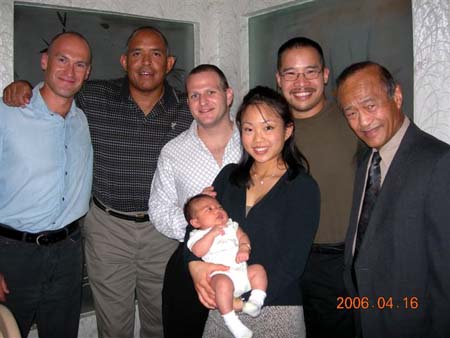
From L to R: Pavel Tsatsouline (RKC Chief Instructor), Prof. Roy Harris (Harris International), Darryl Grauman (Kettlebells Auckland), Dr. Courtney Cheng (RKC II, holding Squealie), me, & Guro Daniel Inosanto (Inosanto Academy) at Squealie's Chinese christening dinner


This post is a little bit of a throwback.

Most of my readers know what kettlebells are and have their own reasons for coming to train with them. But lately, I've frequently found myself having to answer a few questions about why I came to train with kettlebells, so here it is... the most common questions with my straightforward answers. I hope you enjoy.

1. How did you find out about kettlebells?
I first heard about kettlebells sitting in the lobby of the Sports Club/LA with a man I refer to as my white father, Dr. Terry Robinson. Dr. Robinson is one of the pioneers of the physical culture industry, having opened one of the first movie gyms out here in LA, trained stars such as Mario Lanza, and discovered the father of American Kenpo Karate - the late Ed Parker, Sr. His resume is far thicker than that, but that'd take 2 books to cover. Suffice it to say, he's TRULY been there & done that.

I'd head in early in the mornings on Tuesdays & Thursdays to train one of my students and then I'd sit in the lobby with Dr. Robinson afterwards for a while. He talk to me about his thoughts on fitness, training, medicine, and the personalities behind the early years of strength training. He used to always smirk when the trainers would excitedly come in with something they thought was a new invention or discovery and say, "Terry, have you seen this?", and it was something that had been around before their parents were even born.

It was that way with kettlebells too. Even in the 90's, I clearly remember Dr. Robinson showing me pictures of oldtime strongmen training with kettlebells. He said, "Watch, these'll make a comeback, too!"

He was right.

Fast forward a decade, and I'm finishing up an treatment with former Ed Parker student, Dan Inosanto (more well known as the star pupil of the late Bruce Lee). Concerned that he might overtrain or re-injure his back, Guro Inosanto asks me if I'd observe a weight training session that one of his students set up for him.

I go to his Academy the next week and meet Pavel Tsatsouline. The rest, thanks to God and Guro Inosanto, has been history in the making.

2. What is it about kettlebells that attracted you to them initally?
Honestly, nothing. Not a damn thing.

I've hated weight training my entire life up to the point when I met Pavel. There was never a weight training device or method or coach that I'd trained with and really felt like I was doing something that was truly good for my body... aside from mere bodysculpting. I'd always felt some sort of pain the next day that was above and beyond the usual "I just worked out hard" sort of feeling. I'd also seen plenty of guys in the weightstacks moving around like they were in the early stages of being cripples. So in my mind, I'd equated weight training with injury. And even when I first saw kettlebells up close & personal, I had no reason to think they'd be any different.

3. What changed your mind?
Pavel.

Pavel Tsatsouline's method of training is absolutely singular. Nothing I've ever seen out there compares to it. As soon as I heard him open his mouth while teaching Dan Inosanto, I knew he was heading in a direction that was dramatically different from the rest of the pack.

Instead of having Inosanto dive right into tons & tons of reps with some random weight, the first thing Pavel had him working on was a Wall Squat - a sophisticated mobility/stability exercise - to pry mobility into his spine and strength into his hips. Mobility first!

As I listened to Pavel talk about Dr. Vladimir Janda, the posterior chain, the weakness of the glutes, and hip flexor tightness as the root cause for a GREAT DEAL of lower back pain, I realized that I was in the presence of no ordinary trainer. This man was taking my understanding of clinical medicine and turning it on its ear!

The more I listened, the more captivated I became, until finally, after adequate goading from Sifu Inosanto & Professor Roy Harris, who had also begun training with Pavel, I joined in.

4. So what were some of the "benefits" you experienced from kettlebell training?
There are 3 main benefits that I experienced very quickly. I'm sure there are more if I stop to think about it, but these are the ones that stand out the most in my head.
- Lower back pain DRAMATICALLY reduced thanks to Pavel repatterning my lower back and hip movement with "Hard Style" methods
- Shoulder/neck/arm pain & weakness RESOLVED (when almost every other form of treatment short of surgery failed) thanks to ONE exercise - the Turkish Get-Up,
- Lost 20 lbs. thanks to the metabolic repackaging from Hard Style.

Let me clarify for a moment here. "Hard Style" doesn't mean hard in the sense of having to endure bitter hard training, but rather "hard" in the sense of employing selective tension in the body to dramatically increase strength and improve performance without having to bulk up.

As a clinician myself, the first two were enough to knock my socks off. Losing flab and toning up were just icing on the cake.

5. AWESOME! There are kettlebells at my gym now, so I'm gonna ask my trainer to show me some stuff!
You COULD do that, but I have to, as Gray Cook would say, "smack a beehive with a canoe paddle" and tell you that there are far too many trainers out there who think they know what they're doing with kettlebells and actually couldn't tell you the difference between their forehead and their backside in those regards.

Case in point... A well known athlete came to me a couple of years ago with his well-paid trainer in tow and complained that kettlebells were hurting his back. His well-paid trainer came up to me, puffed out his chest, and started doing what he THOUGHT was a kettlebell swing. I had him drop the bell and told the athlete point blank, "No wonder your back was hurting you."

The trainer was demonstrating something hunched over, hardly rooted to the ground, and lacking any semblance of hip extension, posture, or kinetic linkage. I had the trainer sit on the sidelines as I dissected his client's technique and took him from tenuously working with a 35lb kettlebell to confidently and powerfully swinging a 70lb kettlebell, and then swinging TWO 53lb kettlebells.

While it might not've been to coolest thing to do, I kept asking the athlete, "So how's your back doing swinging those HEAVY, HEAVY kettlebells?" Every time he answered that his back was fine, I kept looking over at the trainer and cocked my eyebrow to rub it in a little more.

The kettlebell is a tool. The tool isn't nearly as important as the method that you use to employ the tool to meet your goals. It's like a knife. If you really know how to use a knife in its broadest application, you can basically handle everything from surgery to shaving to sushi to self-defense. If you are clueless and don't respect the knife, you'll probably cut yourself or someone else thinking you know what you're doing.

So while I'm glad that you're enthusiastic about kettlebell training, I think the more important thing is to find someone qualified to teach you. How do you know who's most qualified? Check the list of RKC certified instructors. While some are undoubtedly better than others, this group represents the gold standard in training and qualifications.

Hope this post was somewhat entertaining & informative. I look forward to seeing some of you in Denmark on the 14th and some others in Minneapolis on the 28th!