Showing posts with label gray cook. Show all posts

Friday, December 26, 2014

Endure the pain of discipline or suffer the pain of regret!

This started out as a blogpost that I began over a month ago, but as one of my business consultants said to me this morning, "Lots of good stuff you have gets lost when you're one of those guys who has to keep too many plates spinning."

But this is an important topic that I didn't want to let slide. There are so many thoughts that pop into my head for blogging & writing & recording & podcasting that I really need to have a dedicated multimedia assistant working with me on a regular basis to get more of this $h!# out to you on a more regular basis. I understand that this is an issue for me, and I'm working as best I can on creating a change in processes that will streamline the flow of what will hopefully be useful information out to you. And I really need to thank each & every one of you that's been dropping me messages of encouragement, offering your expertise & help, and sharing my posts all over Facebook, Twitter, and the rest of the web.

You inspire me..... and because of that, I want to leave you with this bit of inspiration as we head into the Holiday season. [EDIT: Yes, I started writing this well before the holidays.]

*********************

More than a month ago, one of my dear friends, Jason Ferruggia posted an awesome tweet that I hold VERY close to my heart.


To me, this is one of the most powerful sentences in training, in sport, and in life... and it is also one of the most grossly misunderstood.

For far too many who read that sentence, the words "pain", "discipline", and "regret", are the ones that stand out, so the reflexive interpretation in American society is that even if you have pain, you need to show discipline by not quitting. Otherwise, you'll regret it. Unfortunately, I think there's been a myopic view of that sentence that has damned countless athletes and injured no shortage of children.

Some folks have adopted the mindset that 'not quitting" means not changing anything and just putting more effort in, even when it's causing you pain or hampering your performance. In those situations, people have mistaken stubbornness for discipline, and I've seen that well-meaning but critical error victimize everyone from youth athletes to rehab patients.

As my big bro, Mark Reifkind (former Master SFG, ultra-marathoner, powerlifter, gymnast, & probably Mossad operative trainer) has said, "Consistency trumps intensity every time."


Let's define "consistency" as "dedication to a pursuit". 

Your pursuit can be an athletic goal, such as placing in a Brazilian Jiu-Jitsu (BJJ) championship, winning a team trophy like the Stanley Cup in hockey, or even something as simple as being able to make it through your wife's salsa class without fatigue or physical pain... because the mental anguish is out of my field of expertise ;-). 

Your pursuit could be a medical one, such as surviving cancer, reintegrating smoothly into civilian society after a particularly harrowing deployment, or getting back on the mat after ACL reconstruction. 

Your pursuit could be a social one, such as learning how to take criticism without getting defensive, overcoming paralyzing shyness, or becoming comfortable with public speaking. 

Regardless of the pursuit itself, we need to be clear about 3 things:
  1. Being clear on our short and long term goals
  2. Being honest with our performance
  3. Being open to guidance

Once we're clear on those, let me just pick one goal in particular in the interest of time... say, conquering a strength training goal, like a PR (personal record) military press.

This was a bottoms-up press that the photographer liked better at an angle. Nothing helps you appreciate rest more than when your photographer is taking multiple shots of you in mid-lift, changing lenses & angles! ;-)


So perhaps it goes something like this...

1) You work hard & consistently every day to increase your press training volume (number of reps). You don't miss days on your program and don't give excuses. You're the ideal athlete and you steadily increase your loads and your performance.... OR you skip days every now & then and decide that you'll just pile on more reps and "go harder" the next time you train to "make up" for your inconsistency. 

2) As you work on improving your press, you plateau out at a weight that's less than your goal regardless of your level of consistency (or inconsistency). 

HERE, where the honesty counts, is where lots of people are made or broken. In this case, you can either, seek out where your form was suboptimal, forcing you to struggle harder than you needed to and likely steering you towards injury, OR you could just stubbornly drive through even harder with more mental dedication in spite of physical deterioration. 

The second of the 2 choices MAY get you to your result, but it won't be sustainable. Your pursuit of that PR press may have forced your rotator cuff, scalenes, and other structures into such profound compensation that you injured yourself badly enough to need a surgical intervention for the numbness, weakness, and/or pain that your arm is now experiencing.

3) When you realize that your performance has plateaued and you can't improve any further on your own, seeking out the guidance of a true expert (and actually taking their advice) can make all the difference in the world. 

Let's say that you seek out a world-class physical therapist (like Dr. Ann Wendell or Dr. Charlie Weingroff) to help you clear up what's causing you the pain, and let's say that they advise you that there are some neck and thoracic spine issues, along with some trigger points, that need clearing up. You're told to stay off loaded overhead lifts (get-ups, presses, snatches, jerks, and even pull-ups) until you've demonstrated an effortless, pain-free range of motion unloaded.

You can either adhere to their advice, put your favorite lift on the sideline for now, go through their prescribed treatment protocols, and troubleshoot all of the dysfunctional movement patterns that were sabotaging your lift in the first place and move past your plateau... OR, since you second guess the experts you sought out, you can still continue to train your press because you might be 3 months away from something like your StrongFirst SFG Level 1 certification, and you're afraid that not pressing will make you weak.

In the latter case, you're being dishonest with yourself and with the person you sought out for guidance and help. And as a result, you just might manage to make it through whatever athletic event you're training for, but you'll be injured for a long time afterwards. Instead of being the picture of strength and embodiment of the ideals you're trying to teach your fitness clients, you'll be the picture of a dumb jock or jock-ette who didn't listen to the professionals who were trying to teach you how to avoid that injury in the first place. What's worse is that you'll likely turn into one of those washed up athletes-turned-coaches who does nothing but sell dreams of his/her glory days to unsuspecting clients who'll likely be injured trying to follow the same methods you used.

See, what most people fail to understand in the over-glorified worlds of sports, athleticism, fitness, and even work is that oftentimes less is more if you have the right priorities. So when Jason Ferruggia posts that you need to endure the pain of discipline, that discipline, when you're not getting the results you want, sometimes takes the form of having the self-control of pulling yourself back enough to take a different approach to the same goal. 

Gray Cook often shares his vignette about taking professional football players off of the squat rack and having them focus on individualized corrective exercise progressions until their Functional Movement Screen scores are "2s on everything with no asymmetries or pain" for months. When these world-class athletes return to their usual strength and conditioning workouts, they're often shocked to see that they not only didn't lose strength, but oftentimes increase their max lifts. The key here is that they had the discipline to follow directions and not just do more of the same. 

Einstein has been well-quoted as saying that insanity is doing the same thing over & over and expecting a different result. Now while that term has been used to brand a workout routine, let's not get it twisted. If you're not getting past the plateaus or the pain that's in your way, it's time to reassess your strategy, your honesty, and your discipline. Regret is a poison that never leaves your soul, so make sure you deal with the factors that contribute to it!


Tuesday, December 16, 2014

Projection: Or how to show your clients that you're not listening to a damn thing they're saying

I can't remember the exact year, but I remember wading through LA traffic to get downtown to the Convention Center for a meeting with my mentor, Gray Cook. When I'd arrived, we sat down for a quick bite at the eatery on the ground floor, where he introduced me to a Scotsman named Alwyn Cosgrove, saying "Our meeting can wait. I want you to listen to this guy."


Gray & I sat in the back of the room, and Cosgrove started to work his magic. Speaking with incredible charisma and the kind of easy confidence that only rock-solid experience can bring you, he started to explain how fitness trainers are oftentimes their worst enemies.

Cosgrove explained that there are some trainers who come into the field & think they know it all already because of their past as a competitive athlete. He shrugged them off from the get-go, saying that many of them would just perpetuate the injuries they were given as kids onto the next unwitting group of people that became their clientele.

On the other hand, another group are people who come into fitness training from whatever background and are hungry to learn more to improve themselves. Those people, he explained, were also often guilty of being their own worst enemies. They hear about some awesome training method that falls in line with their aspirations or their area of curiosity, and they hammer all of their clients with whatever it is that they've just learned or been exposed to. Those trainers, too, were also sabotaging their business reputations by projecting their personal fitness goals onto their clients.

He went on to illustrate it with a particularly memorable analogy that went something like this, occasionally slipping into his native Scottish accent...

*****

Let's say you're a recovering bodybuilder and you just got out of an awesome presentation on hypertrophy. One of your clients is a 50-year-old mum who just had her third child and just wants to lose the baby weight and be able to keep up with her other two kids. Tell me exactly why the f*** would you write a "heavy arms day" into her program. D'ya think she's gonna go up to the other mums after school, flex her biceps & go "Hey! Check this $h!# out!"?

Or do you think it's more likely that she's going to get discouraged after a while of you hammering her with workouts that make her feel sore for days and inadequate and then quit coming to you for training?

So you have to ask yourself this... Are you training your clients like YOU want to be trained? Or are you training your clients to help them meet and then exceed their goals? If you're doing the first of the two, you're not listening to a damn thing your clients said to you. You're projecting what YOU want for YOURSELF onto them. And while it might be well-intentioned, you're being your own worst enemy.

*****

My recall of the exact wording of Cosgrove's presentation is grossly inadequate, but the analogy, the profanity (which left the entire room cracking up and Gray Cook grumbling "How come women clap and laugh when he does that $h!t and they complain when I do it?"), and the essence of his message are spot-on.

If you're in the fitness field, it's a damn good idea to ask yourself with frequency whether you're training your clients in ways that excite, inspire, energize, and empower them towards their goals, OR are you projecting your training goals onto someone else and living vicariously through them while they're the ones paying for it?

Remember: Raw enthusiasm is no substitute for intelligent awareness.


If you're a fitness professional and this DVD hasn't made it onto your radar, grab it. When you've got Gray Cook, Dr. Lee Burton, & Alwyn Cosgrove teaming up to guide your programming to a streamlined process, you can't go wrong!

Wednesday, October 10, 2012

Emotional Attachments: Exercise, Identity, & Addiction

One of the most challenging things to deal with for exercise, rehab, & medical professionals is a client/patient's attachment to a particular form of exercise or sport. As my mentor, Gray Cook, pictured below with Master RKC Brett Jones, has often said, "It's probably easier to get someone to quit smoking crack than to get a runner to stop running long enough for you to get them functioning properly."


This, sadly, is one of the trademarks of modern fitness..... emotional addiction. And it's little surprise.

We spend so much of our lives limiting our movement, starting as early as pre-school. Instead of being outside, running, jumping, playing, and exploring our environment and our movement capabilities as we evolved to do, we're in class for hours each day, forced to sit in partial flexion, and receiving less and less education (and, in many cases, misinformation) as to what our bodies are really capable of.


Over time, our bodies start losing the ability to move in a fundamental fashion. Our cores become flaccid and our limbs become spastic. Yet, society and nature tell us that to be considered vital, to be considered sexy, we have to look great and move a lot.

Notice that I said "move a lot" and not "move well."

When you're hungry enough, you'll eat just about anything someone puts in front of you, and you'll scarf it down like it was the tastiest thing you've ever imagined. When you're dying for movement, or in some cases, dying from lack of movement, you're likely feeling the urge to make up for lost time by putting in a major dose of extra hard, super HIIT (high intensity interval training) or some other means by which you can feel the reward of sweating buckets, tons of adrenaline kicks, and bathe in endorphins bubbling forth from your goosebumps. Over time, you identify yourself with the means through which you experienced that high, and it becomes part of your psyche, your sociology, and your soul.


The problem with that is two-fold.

As Gray has said many times, "YOU ARE NOT YOUR WORKOUT OR YOUR SPORT. YOU ARE A HUMAN BEING."

While we're all driven by a need to belong, we need to realize that belonging to one group over another comes at a cost. You can see it in religion. You can see it in nationalism. You can see it in social cliques. And you can see it in human performance and medicine!

When someone is so driven to be a football player, a drummer, an attorney, a cyclist, a kettlebeller, a P90Xer, a violinist, a martial artist, an exotic dancer, an actor, a researcher, or whatever other pursuit that brings with it a label that pigeonholes how you move, how you live, and how you think of yourself, the body modifies itself to accommodate such specialization.... or as my old professor used to say, "The body is a conservative system."


If you live, work, or train in such a manner that you regularly compromise your body, you have to make sure that you are constantly repeating the IPDE loop - Identify, Predict, Decide, Execute.

* Identify possible dangers in your training, your sport, your job, or your workout routine.

Let me use myself as an example. I'm a lifelong martial artist. I love it. It moves me. It brings me incredible joy. It has been the reason why I've met some of the most influential people in my life..... and it has been the source of some of my most debilitating injuries. Because of my training in the martial art I love the most, Combat Shuai-Chiao, I've taken repeated high-throw falls until my hands didn't function properly.

* Predict how those dangers can affect your quality of life in the BROADEST possible sense.

Again, using myself as an example, that repeated whiplash & impact from hard throws & improper breakfalls is a danger that can affect my performance as a clinician, as a strength coach, as a martial artist, and most importantly as a father if my fine motor skills are impaired by any compromise in the structures and soft tissue around my C-spine.

NOTE WELL: Chronic stiffness and aches (even if not "crippling" in intensity) impair sleep, energy levels, strength, mental clarity, mood, and performance. Just because it doesn't hurt you badly enough for you to stop dead in your tracks, don't think it isn't affecting your performance AND your quality of life. Compensation is sinister.... until it's obvious.

* Decide how you're going to manage those dangers & liabilities in such a way as to minimize or eliminate risk. In a lot of ways, this is the step in which you have to either FULLY and CONSCIOUSLY accept the effects and consequences of what your chosen pursuit is. If you choose to define yourself via your pursuit, then you need to also maintain your fullest abilities as a human being OUTSIDE of your specific skill. For example, if you're a violinist, you need to make a plan to optimize your upper body ranges of motion outside of drawing the bow, finger placement, and keeping your jaw on the chin rest.


For myself, that means figuring out how best to both rehab my neck & injured joints while also minimizing the damage from repeated hard falls. Through lots of research, experimentation, & work, I've identified the prehab training methods that will strengthen my body to be more resilient. I've also identified the passive treatment modalities that I need to implement regularly to keep myself at my functional best. And finally, I realized that using a crash mat is a sign of intelligence and not weakness. Hard-charging athletes need to realize that safety is a sign of long term vision, not wimping out!


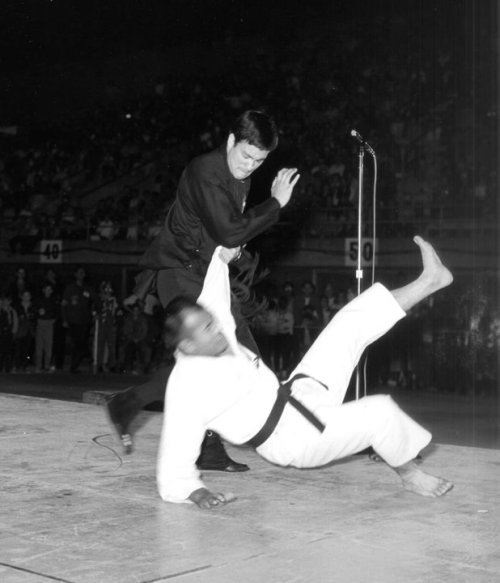
As Guro Dan Inosanto, pictured below demonstrating with Bruce Lee on a hardwood floor, has said many times, the older generations did things a certain way because of what they had available at the time. Ancient martial artists trained hard with no protection because such gear had not yet been invented. Earlier generations trained with some protection because they invented it. We as the newer generations have luxuries afforded to us that were simply unavailable in decades past. Since we have these improvements in safety gear, we should be able to train to a high level for a longer duration than our predecessors with less injury. Not using such safety gear, corrective exercises, or other improvements out of allegiance to "how the old timers did it" is myopic at best.


* Execute the plan you decided on. As Gray Cook would say, "Consistency trumps intensity every time." Doing your prescribed corrective or rehabilitative exercises once or twice and then complaining that they don't work is not a sign of either awareness or honesty. It takes time to develop a neuromuscular habit, and it'll take repeated practice to groove a new, better, safer, stronger neuromuscular behavior pattern.

Don't believe me? Great... Keep doing things your way & prove to me over the long-run that your way is correct. Until then, I'll keep studying, keep practicing, keep refining, and keep making the most of the hard-earned information that we have at our disposal these days.

Do the half-kneeling chops to prevent your lower back pain from the golfing. Do the Tai Cheng to keep your neck & shoulders from aching so much after your hours behind the desk. Do the deadlifting to make sure you're developing the posterior chain & postural reflexes after those long bike rides. Do the soft tissue treatment to make sure you're keeping the optimal elasticity in your muscles. Do the non-sport-specific endurance work to make sure you have the capacity to maintain a higher level of performance throughout a match or event. Do the flexibility/mobility work to make sure your body can handle the unexpected ranges of motion of sport. Do the seemingly remedial stuff to make sure that you do the higher level stuff in an even safer, smoother manner. Do the explosive plyometrics, such as those found in workouts like P90X or training systems like Parkour, that force you to learn how to handle speeds and vectors that are outside of what you're used to.

Outside of movement, change up the music that you listen to on occasion. Vary your eating/dietary patterns. Study a new language. Make new friends. Don't be content with mere survival and don't let yourself become stagnant.

Human beings were meant to be so much more than what most of us conceive of ourselves as today. While we have learned to be tremendous specialists, we've lost so many of our abilities that, generation after generation, it's killing us in a more & more sinister manner. Because the familiar is comfortable, we've become addicts to routine and have prided ourselves on identifying with our addictions.

As MovNat founder, Erwan LeCorre said, "Adaptability is the Holy Grail of human evolution." So let's break our addictions and live our lives in a way that honors our many areas of evolution. This, in turn, will thereby improve how we both live our daily lives and perform in sport-specific conditions.

Thursday, April 8, 2010

Step back to leap forward - Is it Strength you're building or just more Compensation?

You know it's time to update the blog when someone who doesn't read blogs very often asks you what's up with your lack of blog updates. I've been called out & guilty as charged, so here it is... The latest of what's been brewing on my mind & consuming my efforts in the field of human performance lately.


As many of you know, I've had YEARS of problems with my shoulders in some form or another. It started being obvious to me in high school while playing tennis. Practicing hours & hours of serves in the attempt to have a Boris Becker-like cannon and hours of groundstrokes led to a right arm that would essentially go dead after a set of matchplay just before tennis season started during my senior year. Being a right hander, that made serving, volleying, & my beloved forehand harder & harder. So I'd play matches just gutting through the pain, willing my right arm to whip through the strokes, clutching the racquet grip as hard as I could since I often couldn't feel it. The rotater cuff muscles had essentially gotten so swollen that they were cutting off nerve signal and blood flow to the arm. But I didn't know that at the time. I just wanted to play.... desperately.

With that kind of debility, it's little wonder that after high school, I decided to go deeper into another love of mine - martial arts. The full body training I'd found in martial arts such as Northern Shaolin kung-fu put me through different ranges of motion that I'd not trained before, developed stability through stances I'd not really practiced before, and forced me to use both my left and right sides like other prior physical pursuits had not.


Tai-Chi gave me yet another training factor to benefit my body by ratcheting down the speed to super slow-mo and forcing me to pay extra attention to efficiency and softness in my movement, as well as the correctness of my trajectories. I'd done Tai-Chi with my father as a boy, but focusing on it in a more formal manner during my college years made me realize how difficult it can be to let go of muscle tension that we don't need. It forced me to examine what the difference was between being "powerful" and being "rigid" - a lesson that I'm going back to re-examining now thanks to conversations about Z-Health that I've had with Kenneth Jay, Master RKC.

POWER is generated by a change in force (or muscular tension) over time. So the less tension you start with and the more tension you can consciously generate over the smallest possible time frame is your key to being powerful. The maximum change in tension over the shortest amount of time equals your power output.

But pain messes with your nervous system's ability to both relax and to tense. It leaves you in neuromuscular limbo with "guarding" tension that's not so useful when you want to move, want to perform, want to lift, want to fight, or want to really live. That guarding tension starts to create immobility in an area or system that's been injured or threatened, forcing the neighboring joints to try to create more range of motion in order to preserve general task ability.

Such neurological flip-flopping is a damn slippery slope to be on. It's one thing to be able to flip-flop the functionality of any given joint based on your position in relation to the ground or based on intention. Good athletes NEED to have that skill. Just look at any gymnast, grappler, tactical operator, dancer, or martial artist! But when a joint gets locked into one function - hypermobile or mobility-compromised - it's ugly... and usually painful.

Can we compensate around such injuries? SURE!

We do it all the time. And just because you CAN do something, doesn't mean that you SHOULD do it. FMS founder, Gray Cook says, "You might be able to fake and lie your way through the entire Functional Movement Screen by doing every movement with maximal feed-forward tension and denying that you're in pain on every step, but what's your goal? Is your goal to cheat the screen, or is your goal to perform better in your chosen sport and move better in your daily life?"

Honesty's sometimes a hard pill to swallow. For me, I've been so thrilled with some of the improvements in strength that I've made over the years with my strength thanks to the RKC Hardstyle training method that I've allowed myself to, as Master RKC Mark Reifkind puts it, "live in my sport". Having had countless neck & shoulder traumas thanks to martial arts training, especially from the one system I love most - Combat Shuai-Chiao, I've been building my house of strength on a foundation of sand.

I won't lie. Sometimes we fall in love with what (or who) might not be best for us.

It's that way with me & Combat Shuai-Chiao. In all the years I've done martial arts, nothing gives me a greater thrill than having a format to be able to kick, punch, throw, and lock like I do in Shuai-Chiao training. Throwing someone through the air at high speed with amplitude & spin is a rush. And being able to be thrown that way and to hit the ground with a successful breakfall is a rush too. Knowing that the untrained recipient would likely either die, be incapacitated, or seriously injured by a throw that you just stood up from is a rush like no other. Yes, that's me hitting the sand in the pic below.


The only experience I've ever felt like it is going at high speed with live blade double swords with my Krabi-Krabong teacher in Thailand on my last day of training and emerging without a single cut or scrape.

Pressing a 32kg kettlebell is a similar rush. When you've gone from barely being able to hold your tennis racquet after the first set to being able to strictly military press a 70lb kettlebell overhead, it's a rush. No lie. When I walked into Tait Fletcher's Undisputed Fitness in Santa Fe, NM, this past winter, the first thing I did when I saw the kettlebells was walk up to the biggest one I saw (a 32kg) and strict pressed it without even taking my jacket off. Strength is a calling card that lends instant credibility to whatever you're going to say.

But when I tried to up that press strength to tackle the 36kg kettlebell, I ran into problems. The right shoulder that had benefitted so much from the strength training of the RKC method and FMS corrective exercises started hurting more & more. The left arm started experiencing weird strength losses at the RKC II in February after doing VO2Max Viking push-pressing. Luckily Master RKC & CK-FMS creator Brett Jones was there to have a look at me and gave me the most sensible explanation yet. The brachial plexus was getting impinged by my scarred-up deep neck muscles that were irritated by the repeated stretch that was happening at the bottom of the re-rack, and that was severely dampening the motor signal to my left arm. Not a good sign.

You know you own something when you can step away for it for a long while and still do it. It's that way with riding a bike, right? And it's that way with any skill set that your nervous system completely owns in an uninhibited fashion. Injured, sick, sleep-deprived, or inebriated, I can do this one Shaolin hand set and not miss a single movement. There have been entire years (or a few years) that have gone by when I haven't done even 1 rep of this set, yet it's still mine. It's still part of me. And that same thing should be the case with my press. If I can press a 32kg kettlebell one week, and then can't press a 16kg without pain the next in the absence of a traumatic incident occurring in the meantime, I don't own that 32kg press. Do I?

I could be stubborn and just build more on top of more, but then I'd be building more guarding and compensation on top of pre-existing guarding and compensation. So what would happen? As soon as I stop practicing it, my body will reject the load movements that I placed on it. In other words, the pressing strength will shut itself down... as it has in my case.

So I'm having to backtrack a little. It's frustrating to have to put yourself in the remedial education room when you wanna go out & play with the other kids, but I've learned that I'm not a kid any more and I've got an international spotlight shining on me. My time for gross irresponsibility is long over, whether with myself or others. And my first and primary responsibility is to be the best father I can be for my son. If I can't play with him or protect him because my shoulders are in too much pain, what kind of father would I be?

What's on the agenda for my rehab? Go back to what Gray Cook always talks about with ANY discussion about human function.

What's the FIRST prerequisite?..... MOBILITY. So I'm working on restoring maximal range of healthy, unfettered, pain-free, smooth movement to my arms, my shoulders, and my neck - the fusebox of the human body.

What's involved?.... MOBILITY WORK - BOTH PASSIVE & ACTIVE. That means that I'm receiving treatments to seek out the trigger points that are binding up my movement, to mobilize the joints that have been locked down, and to to restore elasticity of the soft tissues. 


That also means that I'm re-focusing my exercise time to temporarily steer away from weighted strength work and towards bodyweight mobility.

How do I do that?.... With my old UCLA Kung-Fu Warmup routine and its variants that include movements, exercises, & concepts from systems as diverse as Northern Shaolin, Capoeira Angola, Shuai-Chiao, & soon incorporating Z-Health drills that've been prescribed by Kenneth Jay.

Through the years of combative arts training, I've damaged my body and made it bear a heavy load by taking punishment without balancing it with equal amounts of restorative practice. As a result, I hit the wall and bounced off it when I tried to up my strength past a certain point. Now it's time for me to backtrack a bit and work on the resilience of my body, maximizing effortless, pain-free mobility again, and then rebuilding my strength to new heights of Hardstyle.

Saturday, August 1, 2009

Training with Legends


I'm sorry it's been a bit longer than usual since my last blogpost. Right now, I don't think I could possibly be busier unless I changed my name to John Du Cane. Normally, I like to share some insights with my blog readers, but this post is going to be a glimpse into one of the most hectic, yet rewarding, days I've had in ages.

This week, I've had the pleasure and honor of having Dr. Vadim Kolganov visiting me here in Los Angeles. As we both share three common loves (Hard Style kettlebell training, manual medicine, and martial arts), there never seems to be enough hours in the day.

We both couldn't help but realize that +2 hour training sessions felt like barely 30 minutes, even when wearing a thick Judo gi top in the Los Angeles summer heat. Whether reviewing Sambo fundamental mobility drills, throw set-ups & entries, pins, submissions, or Kali blade work with Guro John Spezzano, the training sessions were always over far too soon.

Yesterday was an action packed day. Starting with a morning get-together with Dr. Kolganov & RKC Chief Instructor Pavel Tsatsouline for a brief workout, we continued on with a private training session for Raleigh Enterprises President, Mark Rosenthal, who is graciously hosting Dr. Kolganov at the Sunset Marquis Hotel & Villas, and after a couple of errands, returned back to the Rosenthal house for a powwow with Brazilian Jiu-Jitsu/JKD/Kali expert, Prof. Roy Harris.

To watch two brilliant minds and two high level experts like Harris & Kolganov exchange technique and talk about their favorite techniques in their respective fields of experience and preference was about as cool an experience as someone could hope for in martial arts. Dr. Kolganov gifted a kurtka (Sambo jacket) to Prof. Harris and shared techniques from both Sambo wrestling & Retuinskih's ROSS system, and Prof. Harris shared his insights into Kalis Ilustrissimo weaponry, the JKD mindset of streetfighting, and Brazilian Jiu-Jitsu.

Later in the evening, Dr. Kolganov & I drove down to the Perform Better Summit in Long Beach and met up with Functional Movement System masterminds Gray Cook & Brett Jones. Every time I meet up with Gray, no matter how short the interaction, I always leave with some clinical pearl (or 10) that leaves me both dumbfounded and inspired at the same time. By the time we made it down to Long Beach last night, I was dead tired. On the drive back, I was re-energized from Gray's insights, keenly aware of how much and how urgently I have to grow and improve as a clinician.

Today.... R&R.

Monday, June 8, 2009

Reactive Neuromuscular Training: Reverse Psychology for your body

One of the problems that is often identified in sports training, athletic performance, or rehabilitative medicine is when a muscle or muscle group isn't firing to its potential or is firing asymmetrically compared to the opposite side.

When muscle recruitment is less than optimal, that can be a sign of anything from injury to compensation to poor motor learning. Neuromuscular patterns are akin to thought processes or computer programs. Over time and without proper education/training/debugging, corrupt bits of "code" sometimes pop up in the program, making the execution of the program, thought process, or movement dysfunctional.

To deal with this from a neuromuscular standpoint, therapists, trainers, and clinicians sometimes employ a strategy known as Reactive Neuromuscular Training (RNT). RNT operates on the premise that the body will do what it needs to maintain balance - homeostasis.

WHAT'S AT RISK
However, with faulty movement patterns, the body doesn't recognize that the pattern it's maintaining is sub-optimal. Left unchecked for a long time, these simple proprioceptive errors (such as being unaware of the knee position) can lead to a plethora of other compensative mechanisms and injuries (meniscal tears, TFL & IT band pathologies, etc., etc.).

Think of it like a person driving a car who doesn't realize that the passenger side wheels are drifting into the next lane because he's using his driver's seat perspective to keep HIMSELF in the middle of the lane instead of the vehicle. Now on a countryside dirt road and at a low rate of speed, there's not much that could go wrong aside from scraping up the side paneling a little. On a Los Angeles freeway, where speeds can hit well over 80mph during non-rush hour times, such a mistake in proprioception can be fatal.

REVERSE PSYCHOLOGY
So to assist the "driver" in recognizing the error in proprioception, the therapist, trainer, or clinician simply "feeds the mistake" with barely enough force to get the movement pattern to correct itself.

In other words, if the knees tend to drift medially from the midlines of the feet during a squat, then pushing the knees inward while instructing the patient/client to resist the push will cause him/her to activate the muscles that externally rotate the femur (thigh) in the hip more intensely. Instead of telling the body "not" to do something, you give the body something to push against, forcing it to react neurologically and muscularly to implement a better, safer, stronger muscular recruitment pattern.

In this way, the movement pattern in question is used to clean itself up, rather than reverse engineering the movement down to isolating a single muscle in a fixed axis machine. As Gray Cook often says, "Does turning on your glute give you a better squat, or is giving you a better squat a better way of teaching you to fire your glute?"

RNT is a quick means of training the brain & the nervous system to recognize and implement new movement patterns quickly and efficiently, helping them become habituated faster when the body must perform a given fundamental movement.

DON'T THINK... FEEEEEEEEL!
These cues rely on tactile stimuli for maximum learning. So if you're performing a hip bridge and can't quite get the glute to fire the same way on the right as it does on the left, then...

1. Bridge up,
2. Tighten your abs and make sure you're not arching your lower back to cheat a little more hip height,
3. Relax your neck (so that you focus all that much more neurological energy down into your hips & legs), and
4. Have someone gently press down on your hip at the anterior superior iliac spine (ASIS) as if they were dribbling a basketball.

That irregular pressure will give your body something to react to, giving you the tactile cues needed to activate the glutes and create the hip extension against the bouncing push.

Need a more self-sufficient way of experiencing RNT? No problem. Gray Cook has designed elastic bands that allow you to rig up tactile feedback cues for yourself or with a therapist. Click on the pics below to find out more about them!


His exercise tubing program DVD helps take all the guesswork out of it for you, so if you want to fast track your progress, grab this as well...


Hope that helps, folks! We'll be covering RNT, as well as the ins and outs of Hard Style Russian kettlebell training in the workshops that I'll be teaching on my East Coast kettlebell workshop tour from June 20 - 24!

Please check the sidebar on the right for more info on these workshops!

Monday, June 1, 2009

East Coast kettlebell workshops - New England & Mid-Atlantic


Back from assisting at the CK-FMS weekend with my mentors Gray Cook & MRKC Brett Jones, as well as my Redneck brother, SrRKC Jeff O'Connor. To say it was a first class learning experience would be gross understatement.

The new 4 day format for the CK-FMS made for a much less stressful learning experience. The FMS system is a new concept for most people to begin with. To try to learn the importance of it, the execution of it, the analysis of it, and the application of it in 3 days was something akin to cerebral suicide. With the added learning hours an extra day afforded, plus a smoother, more logical teaching format that Brett & Gray came up with, the entire experience was not only less stressful, but far more effective.

And perhaps this time more than last time, the emphasis of sticking to the outline of the screening system and enjoying its effectiveness were hammered home.

Some points to recap...

- Stick to the screen & let the screen mentor you
- Bottom 4 fix top 3
- Movement (or rather "mobility") FIRST, FIRST, FIRST
- Find the asymmetry
- Be disciplined on the front end with sticking to the screen, and be creative on the back end with your correctives.

And finally, for those of you at the CK-FMS workshop from the East Coast, I hope to see you at either New England's 6/20/09 Connecticut workshop (which, in spite of its name, is NOT just for martial artists, fighters, & tactical personnel) where I'll be reviewing FMS movement patterning in addition to in-depth review of Hard Style RKC kettlebell training, or the 6/21/09 Delaware Kettlebell Workshop for the mid-Atlantic region.

If you attended the CK-FMS workshop this past weekend, just e-mail the organizers and let them know. Bring along someone you've wanted to introduce to kettlebell training or Functional Movement patterning, get them registered at the regular price, and we'll bring you in for 1/2 off! We'll make sure to get you in, as it's crucial for you to get the chance to reinforce what you've been taught, and how to see it correctly with your students, clients, and patients!

Needless to say, don't hesitate to drop me a line with any questions you might have.

Looking forward to seeing you back east!

Thursday, November 27, 2008

Shoulder Dynamics - Observation & Mimicry: Part III in the Shoulder Series


Still here in NZ and taking a quick moment to try to append the blog and finish this discourse on the shoulder. Since I'm trying to do this in between running out & doing touristy stuff, teaching, and God-knows-what-else, I'm doing this sorta piecemeal, so please forgive the briefness of these posts.

Human beings learn through one or more of 4 basic routes of input - visual, audio, tactile, or conceptual. Let's define each of these as they apply to functional movement, strength, and potential dysfunction.

Visual means that you see a movement, and you mimic it based on what you saw. This is perhaps the primary means of learning for the vast majority of people... Thus the phrase, "monkey see, monkey do". I don't say that disparagingly, however. Sight offers us perhaps the quickest means of making a "rough copy" of someone else's movement pattern.

Unfortunately, sight relies on our brains to take the information we saw and comprehend it as completely as possible almost instantaneously. Once it's comprehended, then the actual motor neurons and muscles have to interact properly for the observed movement to be reproduced correctly and effectively. If it wasn't this way, everyone would be Bruce Lee after watching Enter the Dragon.

However, I can't tell you how many times I've seen someone try to reproduce a motor pattern after seeing it and managing only the crudest sort of facsimile. In my own experience, I must've tried countless times to imitate Agassi's forehand, Becker's canon-like serve, Sifu James Lin's unstoppable throws, Grandmaster Arthur Lee's thunderous hand speed, Prof. Roy Harris's BJJ positional controls, or Kenneth Jay's pressing technique. Yet more often than not, even after repeated practice, I fall well short.

It's in falling short yet trying stubbornly to achieve the same results that I've often found myself afterwards dealing with some sort of injury, usually due to strain.

So... the easiest way to change the likelihood of injury is to change the focus or redefine the goal. We can see an example of this very clearly with the kettlebell swing. Instead of trying however to get the kettlebell to swing up high and to keep it moving in "Malcolm X" style (i.e., "by any means necessary"), the goal gets redefined to create a swing with a Hard Style Lock at the apex, a symmetrical and pain-free Deep Squat pattern at the bottom, and a well-timed backswing that loads the hips and unlocks the hips and knees only at the last possible millisecond.

That combination of attributes, especially when focused on one bit at a time, creates a process through which we can learn more effectively and safely. The audio cues we get from more advanced movement experts, such as our coaches, masters, and instructors, help us more completely comprehend the facets of movement that need to come together to create ideal technique. Tactile feedback, whether as simple as a smack on the head to remind a fighter to keep his hands up or as subtle as Gray Cook's Reactive Neuromuscular Training methods, help further reinforce the total learning process. With input from the visual, audio, and tactile routes, the conceptual "fermentation" process becomes more rich, and the actual applied skill improves dramatically.

With shoulder specifics, this deals a lot with awareness. At the outset of learning, there's no real depth of awareness that's going on... just crude mimicry.

For example, a pitcher might wind up his arm too far, a tennis player may over-relax the stabilizing muscles needed during a powerful serve or overhead, a martial arts student may lift his shoulder up towards his ear before throwing a punch, and a kettlebeller might swing the kettlebell up so high that his or her neck becomes the core instead of the midsection.

The awareness and understanding of what constitutes proper form (in this case, when stabilizing the shoulder via the lats while in motion) is a HIGHLY necessary step in the process of learning movement that should be emphasized more than upping the number of reps, adding weight, or increasing measurable output. The last thing we should be doing is "adding strength to dysfunction" as Gray Cook would say.

Saturday, September 6, 2008

What do I get if...?

For some reason, it seems like for the past 2 or 3 weeks, I've been repeatedly answering questions like "What do I get if I want to strengthen my back?", "What do I get if I need to keep my knees from collapsing in when I squat down?", or "What can I use to make my rotator cuff stronger since my shoulder hurts all the time?"

I guess it's been a while since I've posted answers to these things, so here's your abbreviated Back-To-School shopping list for items & resources that'll take your training, your treating, and your personal evolution into overdrive.

If you don't have some of these items, that's understandable. We're not made out of money. On the other hand, if you train your brain to stay in poverty mode, you'll never make some of the best investments possible for your professional development and your freedom from pain. I can confess to you publically that every hard-earned dollar I've spent on these items has been worth TEN TIMES as much in returns to me with patients and clients, nevermind my own physical performance.

You blow tons of money every week on bull$h!# like a double mocha venti primo frappolatte'chino that you're just going to slam down, p!$$ out, and get fat from. Why not spend that on resources that will increase your understanding of your field, improve your ability to give your people real lasting results, and take your earning potential to the next level???

I'll try to categorize these as best I can, so here goes...

Functional Movement Screen Technologies
Most all of you know I'm a huge proponent of Gray Cook's Functional Movement Screen Technologies. The FMS has changed the face of physical culture and orthopedic medicine, so there's NO reason at all why a trainer, physical therapist, or any sort of primary care physician worth his or her salt wouldn't be versed in any of these screening methods.

If you're an RKC reading this, stop procrastinating! Register for the next CK-FMS workshop. It's Thursday, May 28 - May 31, 2009 in St. Paul... 4 DAYS of the highest quality and most information-packed time of your life! It's September 6th as I'm writing this, so don't use the "I don't have enough lead time" excuse. Gray Cook, Brett Jones, Danielle Cook, and I will be on hand to teach you the ins and outs of what is perhaps the most brain-numbing & revolutionary stuff you'll ever come across. Not one single person that I spoke to during the inaugural CK-FMS workshop this past August came away feeling like they didn't get enough highly applicable information. No fluff here, Baby!

In fact, as of today, I'm going to make the CK-FMS a requirement for any RKC in the KBLA family who's running a satellite group. Within 2 years of you earning your RKC, you're required to attend the CK-FMS, where you can re-cert your RKC with your Snatch Test numbers. Nobody should be training someone else if they don't know how to identify movement problems and can't provide some sort of solution. That's why the old-time Chinese martial arts masters all knew some degree of Chinese traumatology. If it got injured under their roof, they had the responsibility to fix it. KBLA's all about skill & responsibility.

Now, if you're not an RKC, you're allowed a little more room to procrastinate.

TO THE GENERAL PUBLIC: If you don't want to be "bothered" by getting to learn the Functional Movement Screen, buying the FMS Screening kit, and all of that, no problem. Unless you're a fitness, athletic, or medical professional, there's really no need for you to buy the toys and take the courses.

However, you DO need to know how to move from your "core". How do we address that? - The DEADLIFT!

Wait.... not crunches??? Not rolling around on my Swiss Ball??? Not using the electro-stim Bruce Lee ab-shocker thing??? No, Dude.... the DEADLIFT!

The Deadlift is one of the MOST OVERLOOKED weight-training exercises and fundamental movement patterns. It serves as both a screen and a correction for many individuals with a plethora of pain syndromes and movement problems. If you're a kettlebeller, then the Deadlift should have been the FIRST movement you learned to execute properly with a kettlebell in your hand. If you didn't, go back to your trainer and ask for your money back. The hot, sexy, showy lifts are nothing (and in most cases, dangerous) if you don't have ROCK-SOLID mastery of the Deadlift.


Secrets of Core Training: The Backside by Gray Cook & Master RKC Brett Jones deals with all of the stuff I just discussed, but in crystal clear detail. You get not only the best explanations of what the core is all about, but also a clear cut progression of how to find your weaknesses, discover their component parts, and shore them up into an ironclad body.

Once you've mastered the info on Secrets of Core Training: The Backside and you're moving with more power, ease, and posture, you're ready to move on to Secrets of the Hip & Knee. Here, you'll get even more corrective exercises to shore up even the tiniest issues with your lower body movement patterns.


TIME OUT:
- "Why are you talking about movement patterns so much? I don't have problems with movement. It's just that my knee hurts when I squat down!"
- "The problem's not my core! My abs are strong and I do hundreds of crunches a day! My lower back hurts!"


Yup, I heard you the first time, and you'd be damn shocked how many of you out there with these sorts of aches and pains actually have those aches and pains because of allowing your body to employ $h!##y movement patterns. You think you know how to sit, stand, walk, run & all that, but your body's been compensating for heinous habits by piling on one cover-up after another. And that pain that you're feeling now? It's your body's way of telling you that your cover-ups aren't going to cut it any more and you've gotta deal with the underlying neurological issues. (Wow, sounds like something that you could extrapolate easily into a psychotherapy session, don't it?) Now let's get back to the discussion at hand.

After you've addressed the "root" of your body by learning and applying all of the information in the first 2 DVDs that I discussed, the next thing you're going to need is command, control, and comfort in your upper body. That's where Secrets of the Shoulder comes in. Brett & Gray pulled the door right off the hinges with this 2-DVD set.

Got shoulder, neck, or mid-to-upper back pain? Get Secrets of the Shoulder, study it like a nerd on speed, apply it like a mad scientist, and then resurface feeling like a new person!


What's so great about this stuff and why the sales pitch? Simple... The quality of information that Gray & Brett are doling out for you is SOOOOO good that most of your doctors won't have a damn clue about this, and they're the people you're going to see for solutions when you have an ache or pain! The problem is that the prescription meds and most of the rehab exercises you're being given are USELESS. So you're wasting money and time and NOT getting any real relief for your rotator cuff tendonitis, your achy shoulders, your tight neck, or the numbness and tingling that's going down your arm.

Now if you've handled all of that with panache and poise, gone through each DVD at least 3 times to pick up all the details you missed during your 2 previous viewings, and you're pushing into the real essence of functional movement, then you're ready for the last installment in the Secrets of series.... Secrets of Primitive Patterns.


Now while there's a ton of other stuff I could recommend to you, any of the info on even the first 3 DVDs is MORE than enough to keep you occupied for a LONG time. Get it, open it, watch it, study it, apply it, and BENEFIT from it! Once you've done all that, share the benefit with others!

Monday, September 1, 2008

TOOTH & NAIL!

"We defend our weaknesses, our compensations, our insecurities, and our delusions tooth and nail."
- Me, Clover Park Tai-Chi class... 8/23/08


When it comes to the workings of the human body, there are two people who've revolutionized my thought processes - Pavel Tsatsouline & Gray Cook. If you've been following this blog at all, you have a decent idea of who both of those men are.

Gray has been known to say that "The most talented athletes aren't necessarily the ones who have perfect movement screens, but are often the ones who compensate for their shortcomings better than the rest."

He went on to say ominously, "But that doesn't mean they're the most durable if their movement screen scores are low."

It's that same way for people in general. The people who are often the most successful or the most wealthy or the strongest or the most famous or the most vociferous aren't always the people with the best internal set-up. Oftentimes, we're the people who are just better at compensating than others.

To give you an example, I'm going to speak about one of my acquaintances. To maintain total anonymity, I'll refer to him/her as "Them". Gosh,.... sounds awfully southern, don't it, y'all?

Them's one of the nicest people you'll ever met. Them likes to think of themself as positive & progressive. But when Them views themself in the mirror or is faced with criticism, Them becomes very emotional & defensive, not realizing that Them's tone of voice turns from a rational adult to a whiny little brat, bordering on the edge of tears. The defensiveness, the frustration, and the fear in Them's voice, mannerisms, and body language is obvious to the educated/experienced eye.

Them loves the quality of the information I give out and is eager to be proficient in it and teach it, but Them hates to be on the receiving end of my criticisms. Them may reflexively snap back at me, slink off to the corner to cry, or just outright quit and come back after a few weeks of nursing Them's feelings.

See, here's exactly where Gray's statements come into play for us on a deeper level than just athletic performance. These are truths that apply solidly for who we are as human beings.

People love to be praised, patted on the back, recognized for achievement. But people HATE to stack up as less than someone else. You'll see grown men cry and rational individuals behave like wounded animals when you point out their deficiencies or asymmetries. It's that way for plenty of the seniormost people in ANY field of endeavor, and it's certainly that way for EVERYONE on a human level.

We compensate socially in no shortage of ways... from half-a$$ed, meaningless apologies to Jedi mind trick-style diversions, to politicking, to verbal passive-aggressiveness, to simply disengaging. Depending on your background, your education, your training, and your priorities, you may use any of these "tools" or countless others to protect your paradigm.

But life and the world around us keeps evolving.

Just like the RKC II's certification requirements have evolved, so too does the rest of our world. People who went through the RKC and RKC II before the requirements became as solid as they are now have one of two options - to $h!t their pants in cowardice, and whine and complain about how unreasonable those newer requirements are, OR to accept that the cert is nowhere near as meaningful if it's not earned through real blood, sweat, and sacrifice.

Psycho-social evolution is no different. Everyone wants a pat on the back, a moment in the spotlight, and/or the assurance that all is good. All is NOT good. If you were reading the section above about "Them" and thinking "Is he talking about me?" or "He certainly isn't talking about me", then I'm talking about YOU. Instead of concerning yourself with what I think, why not prioritize your own self-discovery process and developing the honesty, courage, and persistence needed for the self-strengthening process?

As I was cleaning out some old papers from back in my early college days, I came upon a scrap of paper that I'd jotted a quote down on. My first and only Shotokan Karate master, Tsutomu Ohshima, once said during a class that "We need to have the courage to look inside ourselves and see the ugliness and weakness that we try to hide from others and often from ourselves. If you can look inside with honest eyes and have the courage to see your own sickness and weakness, then you can cut those parts away from yourself and become truly strong."

Inertia allows us to make plenty of excuses about why we can't evolve. Entitlement and denial allow us to treat everyone who calls us on our bull$h!# like criminals or lunatics. We should do away with all of that.

Those who are fighting for evolution are the ones who fight to identify their own weaknesses and struggle mightily to overcome them by predicting their defensive behaviors, deciding to put a stop to such cowardice, and executing a corrective strategy.

As the late Rev. Kensho Furuya once told me, "People think I'm preachy when they read my column sometimes, but I often write to remind myself of what I should do." The same applies for me as well. Gray's teachings apply to so many more levels of life than the casual reader might comprehend. Instead of simply adding strength to dysfunction, let's clean out the underlying dysfunctions & pathologies, reboot our systems, and then add beautiful strength to a rock-solid foundation.

Wednesday, August 20, 2008

The UCLA, CK-FMS, SFMA de-brief


Finally... I know how overdue this is, but, man... what a month!

I think I've been using the excuse that I've been waiting for people to send me photos of me from UCLA & CK-FMS to procrastinate from writing this post, but I'm getting this done today, come hell or high water. (Addendum - the pic above is courtesy of Heidi Rothenberg, RKC, and just received on 8/25/08)

The UCLA-RKC
Most of you've already heard about the adventures that I took KJ on during his stay here in LA, so I'll leave those out of this post. I will, however, say that the UCLA RKC marked my domestic debut as a Team Leader, having made my international debut back in Budapest.

Just prior to the RKC, there were a few hours when Brett Jones, MRKC, KJ & I were sitting here in this dinky little home/office room of mine and powwowing just before the cert. I have to say that that was one of the cooler moments in memory. It's always a good thing when the guys you looked up to as untouchables become your friends & colleagues, but then once you know them, you respect them even more.

The KBLA crew fielded no shortage of personnel for the UCLA cert, and each one of them carried themselves stunningly. I've been hearing from someone almost every other day about how well my students did at UCLA, and I have to thank them for their hard work and their display of pride. With few exceptions and despite their fatigue following the weekend's strain and exhaustion, everyone associated with KBLA stayed after the RKC was concluded to help Dragon Door with cleanup and packing. That kind of team spirit is what makes KBLA so great to be at the helm of. Having people like that makes me want to give my all to them time & time again.

"Trusty" Justin Garfield, USMC, RKC helped KJ & I load, haul, and unload an obscene number of kettlebells from UCLA to my apartment. This place looked like Fort Hard Style for a few days afterward.

In the aftermath of UCLA, I felt completely drained. The blazing sun overhead, the expectations from this being the first RKC cert in Los Angeles AND at my alma mater, and just being on point for 3 non-stop days took its toll, and the Viking & I just crashed out hard afterwards.

Reflecting back, there were several high points along the way.
- Listening to Coach Dan John speak on training methods and high goblet squat presentation. The importance and value of so much of what he taught sailed over the heads of most people there. I know I only caught a modicum of what he was trying to share with us.
- Co-presenting the NGU/TGU with Rif
- Working with Steve Belanger, RKC & Michelle Kilikauskas, RKC II as my assistants. I have NOTHING but high praise for them!
- Sharing the field with other Team Leaders, Seniors, & Masters that I respect and admire
- Meeting so many highly motivated and disciplined RKC candidates and working with them as they developed into RKCs!

One point of discussion was the quality of certain assistants.
The RKC is not a place to strut, to sit around, or to be aloof for assistant RKCs.

It's a place and occasion to do the following, in the following order:
1. to recertify and demonstrate your technical proficiency in all of the RKC I requirements,
2. to demonstrate your ability to teach those skills to others as an assistant to your Team Leader, and
3. to pick up on all the fine points that you missed in your previous excursion through the RKC as a student.

Rest damn assured that KBLA's going to make sure that each & every RKC that we field as an assistant is more than ready to do all of those. Anton Summers, RKC did us all proud at UCLA. There's MUCH more to come from many more waiting in the wings.

And now that we've got representatives in the O.C., we're branching out as Kettlebells Orange County too!

The Certified Kettlebell - Functional Movement Screen (CK-FMS) workshop
What a reunion!

KJ, Doug Nepodal & I were on the same flight out of LAX, and we got the red carpet welcome from Matt Johnson, RKC. Matt took time out of his day to scoop up the Three Amigos from MSP and bring us to the hotel. Big thanks to Com. Matt for such hospitality!

The first moments as KJ, Doug & I rolled out, getting into the Holiday Inn was like being back at the reunion you always wished your reunions were like. We got our rooms and met up in The Liffey (the in-house restaurant) later that evening, and you'd swear you've never seen so much warmth and happiness in one place. That kind of camaraderie left a lasting impression on us all, no doubt.

The CK-FMS workshop itself was a thing of absolute beauty. I'd originally signed up just for the sheer pleasure of being a student, but that was prior to having a couple of meetings with Gray Cook & Dr. Lee Burton, who honored me with an invitation to assist. I'd originally been exposed to the Functional Movement Screen directly by Gray a couple of years ago when he gave Pavel & I an in-depth introduction to it at the Beckham Academy. I'd been practicing it on my own as well, studying bits & pieces here & there, along with the "Secrets of..." series. I met up with Gray & Lee in Long Beach for their Perform Better workshops earlier this year, and then flew out to Indy to go through the full FMS course itself, where I ended up assisting (much to my shock & surprise). When Gray told me that he wanted me to assist at the CK-FMS, I was speechless.

Despite studying the reference materials, I was amazed at how many little fine points I'd missed or overlooked as the workshop progressed. Throughout the weekend, as much as I thought I'd prepared to assist Gray & Brett, I felt like I was just struggling to stay abreast of the knowledge that the two of them were doling out. Danielle Cook, RKC II, Gray's wife and a well-practiced FMS instructor, put me a bit more at ease when she commented that a lot of this material she'd never seen either, as it was the first time Gray & Brett were presenting it together. As the two of them were teaching, I felt like I had my lips on a firehose that was on full-blast. I had to keep checking my skull every few hours to see if there was an exit wound yet.

With even the massive amounts of experience and learning that a high-level coach like Rif has, he too was remarking well before the end of the day, "My brain hurts!"

It wasn't until the last day when Brett confessed that he was taken off guard and blown away by something Gray explained or presented that I started to feel a little more consolation. You can rest assured that for the coming months, I'll be hip deep in the Gray [Cook] Matter.

The Takeaway... Hard Style and the RKC System is an incredible body of knowledge that prepares the human body for ideal movement and true strength. It fits in with the FMS like a hand in a glove, and I'm just more inspired to learn and practice more of both.

The Aftermath... After spending the weekend with people I love & respect like Toomey, the Blifferts, Engum, Whitley, O'Connor, Pavel, KJ, Rif, and the like, leaving was a serious downer. If the Iron Tamer himself hadn't called me and asked if I was back home & bummed out too, I'd have thought someone put a downer in my Cheerios. There's really something to be said for the kind of family that's come out of The School of Strength!

Oh yeah... and if you have pics of me or Courtney, please e-mail them to me!!!

---

OK... sorry about the prior incompleteness. Had to run down to the Inosanto Academy to train the man himself.

SFMA debrief
At Gray Cook's encouragement, I signed up for the Selective Functional Movement Assessment Course, taught by Dr. Kyle Kiesel. This course focused more on diagnostic tools for physicians, while still operating on the same paradigm as the FMS.

There are still basic tests that are scored, and the focus for treatment is refined down to a very formulaic means. Courtney & I had dinner with Dr. Kiesel after the course and both of us gave him the same feedback:

As medical professionals (east & west), we were both taught plenty of diagnostic tests and how to use plenty of diagnostic tools, from pulses to MRIs to serum glucose tests. No matter what branch of medicine you're in, if you're learning from a top-notch mentor and a really skilled clinician, you're taught to go for the keystone, the central point of dysfunction or disease. When you treat that effectively, all the other secondary symptoms will usually improve.

The SFMA & FMS technologies give everyone involved in human performance a means of identifying dysfunction, aiming us toward the key problem, and rectifying it with either corrective exercise, intervention, or referral. This is the essence of being a useful participant in another person's true wellness.

As I said this morning at the Inosanto Academy, I'm so blessed to have access to good people like these with knowledge so deep. Life's good.

Oh yeah... and send me pics from UCLA or CK-FMS if you've got 'em!

Friday, June 20, 2008

And for this weekend...

Man, I can't believe it... About to get on another plane. Luckily, this is just a short trip.

As I was writing a note for my KettlebellsLosAngeles Newsletter, I liked the content so much that I figured it might be beneficial if I posted the message here too.

Enjoy, Folks!
-------------
Hello, Kettlebellers!

One of these days, I'll be able to follow my own advice and PROPERLY moderate my workload, but right now, it's just moving at the speed of absolute insanity. I'll be heading out of town this Sunday morning, but there will still be plenty of KBLA's RKC-certified instructors and instructor candidates on hand to teach in my absence. My wife, Dr. Courtney Cheng, RKC II, may be under the weather, so don't expect her to be on hand.

For this week's training, there are 2 things I want people to work on:

1. Maximum Volitional Contraction (MVC), and

2. Efficient Explosiveness (EE).

Through my training with Pavel Tsatsouline and my conversations with Gray Cook, both mentors of mine, I've realized that more often than not, people think they're contracting a muscle to its maximum (i.e., generating an MVC) when they're really not.

How does this happen?..... Simple... we lose touch with our bodies and develop really awful habits of motion and of stability. Some people refer to this as having poor ergonomics, but it's also an issue of having rotten movement patterns.

What's the first, most vital movement pattern that people tend to unlearn?.... BREATH!

Why is breath crucial?..... Aside from the obvious issues of asphyxiation, how we breathe is one of the most fundamental factors deciding whether we're in an efficient and powerful state (parasympathetic nervous system dominant - i.e., calm & in control) or a highly inefficient and weak state (sympathetic nervous system dominant - i.e., fearful, panicked, defensive, & in denial).

When I was discussing this with Gray Cook this past weekend, I almost thought that I was sitting in a psychology class, but these are all the SAME messages that we hear in Traditional Chinese Martial Arts training, starting with Chi Kung (aka. qigong). We try to shift our breathing down to the lower abdomen to train diaphragmatic breating, instead of breathing in our upper chests. As Brett Jones, MRKC, said in Secrets of the Shoulder, the lungs expand downward because of our diaphragms, and that's 2/3 of our lung volume!! But in many cases, we've unlearned how to breath properly. Want proof? Watch a baby breathe. The belly rises and falls, not the upper chest.

And how does that tie into Russian Kettlebell training?..... The sharp and short "sssst!" sound you make on exhalation while doing KB ballistics is a rapid intraabdomenal compression, coming from your lower abdomen. If you try it from your chest, it's weak. Not as many stabilizing muscles fire. Now try it exhaling sharply, almost from your groin. Feel how different it is in terms of the power you generate???

So this is how class is going to run this weekend as far as a rough schedule:

- 10 minutes of joint mobility (basic warmup)

- at least 5 minutes of VERY focused lower abdomenal breathing:

*Start with your feet shoulder width and parallel, relax your legs, reach up to the sky with the vertex of your head, and overlay one palm on your sternum and the other palm just under your belly button. Now breathe slowly, evenly, and deeply.
*You should feel the palm on your lower abdomen push outward against your hand as you inhale, and fall back in towards your spine as you exhale. The hand on your sternum should ideally not even move.

- Divide the class up into beginners, semi-experienced, and RKC candidates

- One of the RKCs takes the beginners & semi-experienced through the Hard Style Lock, wall squat, KB deadlift, KB swing, and Naked Get-Up. Remember that for a first-timer, less is more. The Hard Style Lock is a crucial skill where you get your first exposure to MVC. If you "think" you're clenching your glutes or "think" you're locking your knees, the odds are pretty damn good that you COULD and SHOULD engage them even MORE forcefully. We live in a "good enough" society, but you need to remember that "good enough" means "first idiot injured from carelessness" in Chinese.

You want to be able to pull off the ENTIRE 5 point Hard Style Lock with real synchronicity and your real Maximum Volitional Contraction, and the KBLA instructional crew will show you how. As Pavel always says, "Tension equals strength." So learn WELL how to generate tension right from the get-go..... A leakage in tension is a liability in structure!

NOTE: For the instructional crew, if you see someone zoning out or ignoring your instructions, don't let them touch a kettlebell. Have them do bodyweight exercises until they learn how to move properly. Moving improperly with a kettlebell is just a means of reinforcing compensation mechanisms, and as the saying goes, "nothing good can come of it."

- RKC Candidates: Instead of doing the Hard Style Lock and all of that, grab a relatively heavy bell and do 5 - 10 swings with 2 hands, and then 5 swings per hand of 1 handed swings. You're trying to achieve 2 things: a) maximum explosiveness from the legs and glutes, and b) note the feeling of smoothness at the bottom of the arc with the 1-handed swing.

Once you've done that, go through your snatch test with the strict RKC rules. I want to see numbers posted on my blog under the corresponding post. Coach each other as you go through it, forcing each other to adhere to maximally correct form.

THIS RKC SNATCH TEST is your lesson in Efficient Explosiveness. What are the salient points of EE?
*Sensing exactly how much muscular force/explosiveness to use to get the KB to float up to the apex
*Guiding the arc of the KB more vertically than diagonally. If the KB bounces on your wrist, it's usually because you're either overthrowing the bell or you're finishing the snatch with the apex in front of you. Adjust accordingly.
*Sense the smoothness at the bottom of the arc. Lowering the KB from the apex doesn't mean "turn your brain off". Rather, you should be just as mentally engaged and aware of the feel of the bell while you're lowering it as you were while you were snatching it upward. If it feels like there's any jerkiness or strain, you need to adjust your form.

You are each allowed only ONE attempt on Sunday. Rest well on Saturday and bring your A game!

Once you've gone through your snatch tests, rejoin the class and spread the lovin'.

This weekend's circuit will be designed by KBLA's own Dr. Jeff McCombs, DC, RKC, if he's present. Doc Jeff is highly competent in both putting a hurt on you and taking the hurt off of you!

Train hard, train smart, train kettlebells!

"Doc" Mark Cheng, RKC Team Leader

Wednesday, June 4, 2008

Life at the speed of caffeine --- When it gets too good to turn down

Man, just when I thought things were calming down for a little bit, life gets too good to tune it down.

All of the sudden, I've got a bunch of students who are highly skilled and extremely motivated and are gunning for the September 2008 RKC kettlebell instructor certification workshop in St. Paul. The KBLA crew is spreading its wings! So needless to say, now I'm looking at the possibility of heading out there for moral support.

Add to that, this weekend is a CEU seminar that I need to renew my acupuncture licensure, next weekend is the Functional Training Summit that Gray Cook and Lee Burton, as well as Dr. Stuart McGill, will all be presenting at, and the following weekend is supposedly some down time in Vegas. So there goes the month of June.

Next month, another required CEU seminar, a weekend of "rest", one of my best friend's wedding, then August starts with the UCLA RKC instructor certification workshop and continues with the CK-FMS workshop (where Gray Cook and Brett Jones will be presenting the Functional Movement Screen and kettlebell-based corrective movement strategies) the following weekend.

If you told me even 5 years ago that my life would turn into a series of opportunities that are exactly what I've been looking forward to and I'd be in a position where I have to look at how to prioritize and turn down opportunities that give me the chance to interact with guys who are my heroes (and all while getting PAID), I'd have told you to ease up on the crack pipe. Life is REALLY that good!

On the other hand, life is rough in a way I never anticipated. Having to prioritize with opportunities like that presents me with a challenge I NEVER anticipated. In some ways, it's MORE dangerous than having too few options, since now prioritizing is even more important. Choosing to spend time in an unbalanced way can jeopardize all that I've worked so hard to achieve. If I spend too little time with my family because I'm trying to make the most of these opportunities, I risk losing the real jewels are in my life. Similarly, if I spend too much time on work and not enough time training (as I have been more guilty of lately), I risk losing the sharpness of the edge I've worked hard to hone.

In all situations, good & bad, there's one factor that keeps you from making poor decisions - INSPIRATION. When you look at what truly inspires you (whether God, family, country, teachers, or whatever else) and you make careful decisions based on your sources of inspiration, you will find yourself committing your efforts to what builds a strong life for yourself and for those around you.

As my friend, Boris Bachmann, RKC, told me, sometimes I make these blog posts just as much to remind myself how to choose and how to act as to light the path for others. And sometimes, it's the guidance from my own blogposts that I hear from my students' mouths when I veer off course.

-----
ADDENDUM - 2130 hrs

Life has a great way of putting the brakes on when you drive yourself a little too hard, too fast. Teaching a full load of clients, treating a full load of patients, driving all over SoCal, and not listening to the occasional whimperings of my body may not have been the smartest thing to do. But I was having fun doing what I was doing. Wanna know how much fun I'm getting into? Three letters say it all.... FMS. Suffice it to say that the Chinaman's got somethin' big cookin'!

Back to the reality of the present... Down with a little flu, it looks like I won't be heading to Cerritos tomorrow to work on editing the CSC book. After a day and a half of questionable GI activity and an evening of swelling glands, I'm going into hibernation again. G'nite, folks.