Saturday, May 23, 2009

Memorial Day weekend kettlebell training


As has become KBLA tradition, when there's a holiday that honors those who sacrifice in the name of our safety, we follow suit.

I don't need to remind you all of the importance that the men & women in uniform hold to your country, to your society, and to your way of life. If I do, then you might want to pull your head out of the sand.

There are a few individuals whom I've seen poo-poo the efforts of civilians to pay tribute to those who've made the ultimate sacrifice while serving their country. Those individuals might want to perform a serious gut check and take a long look in the mirror before blurting out any more garbage.

This weekend, this Sunday, if you've been on deployment or are currently active duty, come by.
Come train.
Come get the best that the RKC system of strength and kettlebell training has to offer.
And come as our guest.

We salute you.

Friday, May 22, 2009

More pics of the new KBLA gear

Yeah, I know... the Denmark debrief will be posted later. So much to catch up on right now, and still fighting the jetlag. I have no idea how constant travellers like Sifu Dan Inosanto do it.

Here are a couple more pics of the new KBLA long & short sleeve T's fresh from the field of battle in Copenhagen... as well as a pic of me stylin' the new KBLA RKC jacket.

Here's Dr. Zolnai Vilmos, a Hungarian Shotokan champion, a dental school professor, a student of the legendary Gabi Katschthaler, and Team Cheng's technique champion styling the new long sleeve T-shirt


Shipping Options
Please specify size S-XXL


And another pic of Danish Army Sgt. Kevin Lassen with me in the KBLA short sleeve T.


Shipping options
Please specify size: S - XXL


The backs of the shirts have the same logo, but smaller, just underneath the rear neckline URL. It's exactly like what you see on Squealie's shirt below. Remember that the prices have shipping & handling included, so a short sleeve shirt to Europe is just $30 total. These are selling faster than I expected so get yours while they're still in stock!

Sunday, May 10, 2009

The new KBLA gear!


We'll get the adult pics posted soon, but these pics of Squealie stylin' the KBLA T-shirt should give you an idea of what we've got. These 100% cotton black shirts are available in short & long sleeve. The adult sized shirts have a large logo on the front and a smaller logo in the upper back, crested by the KBLA URL.


To order, just follow the directions on the drop down menus, and we'll get your gear off to you once I'm back from Denmark. Orders placed between May 10 & May 19 will ship out on May 22.

NOTE: The KBLA RKC gear (such as jackets & dri-weave shirts) is for only those RKCs who train with me regularly.


Shipping options
Please specify size: S - XXL


Shipping Options
Please specify size S-XXL


Wednesday, May 6, 2009

Why kettlebells?


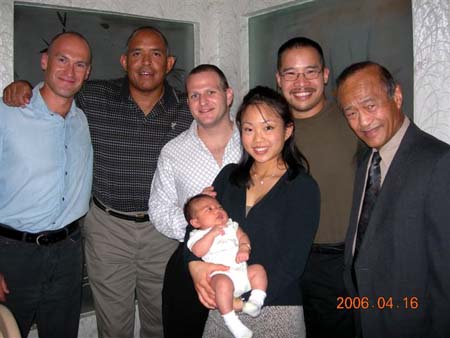
From L to R: Pavel Tsatsouline (RKC Chief Instructor), Prof. Roy Harris (Harris International), Darryl Grauman (Kettlebells Auckland), Dr. Courtney Cheng (RKC II, holding Squealie), me, & Guro Daniel Inosanto (Inosanto Academy) at Squealie's Chinese christening dinner


This post is a little bit of a throwback.

Most of my readers know what kettlebells are and have their own reasons for coming to train with them. But lately, I've frequently found myself having to answer a few questions about why I came to train with kettlebells, so here it is... the most common questions with my straightforward answers. I hope you enjoy.

1. How did you find out about kettlebells?
I first heard about kettlebells sitting in the lobby of the Sports Club/LA with a man I refer to as my white father, Dr. Terry Robinson. Dr. Robinson is one of the pioneers of the physical culture industry, having opened one of the first movie gyms out here in LA, trained stars such as Mario Lanza, and discovered the father of American Kenpo Karate - the late Ed Parker, Sr. His resume is far thicker than that, but that'd take 2 books to cover. Suffice it to say, he's TRULY been there & done that.

I'd head in early in the mornings on Tuesdays & Thursdays to train one of my students and then I'd sit in the lobby with Dr. Robinson afterwards for a while. He talk to me about his thoughts on fitness, training, medicine, and the personalities behind the early years of strength training. He used to always smirk when the trainers would excitedly come in with something they thought was a new invention or discovery and say, "Terry, have you seen this?", and it was something that had been around before their parents were even born.

It was that way with kettlebells too. Even in the 90's, I clearly remember Dr. Robinson showing me pictures of oldtime strongmen training with kettlebells. He said, "Watch, these'll make a comeback, too!"

He was right.

Fast forward a decade, and I'm finishing up an treatment with former Ed Parker student, Dan Inosanto (more well known as the star pupil of the late Bruce Lee). Concerned that he might overtrain or re-injure his back, Guro Inosanto asks me if I'd observe a weight training session that one of his students set up for him.

I go to his Academy the next week and meet Pavel Tsatsouline. The rest, thanks to God and Guro Inosanto, has been history in the making.

2. What is it about kettlebells that attracted you to them initally?
Honestly, nothing. Not a damn thing.

I've hated weight training my entire life up to the point when I met Pavel. There was never a weight training device or method or coach that I'd trained with and really felt like I was doing something that was truly good for my body... aside from mere bodysculpting. I'd always felt some sort of pain the next day that was above and beyond the usual "I just worked out hard" sort of feeling. I'd also seen plenty of guys in the weightstacks moving around like they were in the early stages of being cripples. So in my mind, I'd equated weight training with injury. And even when I first saw kettlebells up close & personal, I had no reason to think they'd be any different.

3. What changed your mind?
Pavel.

Pavel Tsatsouline's method of training is absolutely singular. Nothing I've ever seen out there compares to it. As soon as I heard him open his mouth while teaching Dan Inosanto, I knew he was heading in a direction that was dramatically different from the rest of the pack.

Instead of having Inosanto dive right into tons & tons of reps with some random weight, the first thing Pavel had him working on was a Wall Squat - a sophisticated mobility/stability exercise - to pry mobility into his spine and strength into his hips. Mobility first!

As I listened to Pavel talk about Dr. Vladimir Janda, the posterior chain, the weakness of the glutes, and hip flexor tightness as the root cause for a GREAT DEAL of lower back pain, I realized that I was in the presence of no ordinary trainer. This man was taking my understanding of clinical medicine and turning it on its ear!

The more I listened, the more captivated I became, until finally, after adequate goading from Sifu Inosanto & Professor Roy Harris, who had also begun training with Pavel, I joined in.

4. So what were some of the "benefits" you experienced from kettlebell training?
There are 3 main benefits that I experienced very quickly. I'm sure there are more if I stop to think about it, but these are the ones that stand out the most in my head.
- Lower back pain DRAMATICALLY reduced thanks to Pavel repatterning my lower back and hip movement with "Hard Style" methods
- Shoulder/neck/arm pain & weakness RESOLVED (when almost every other form of treatment short of surgery failed) thanks to ONE exercise - the Turkish Get-Up,
- Lost 20 lbs. thanks to the metabolic repackaging from Hard Style.

Let me clarify for a moment here. "Hard Style" doesn't mean hard in the sense of having to endure bitter hard training, but rather "hard" in the sense of employing selective tension in the body to dramatically increase strength and improve performance without having to bulk up.

As a clinician myself, the first two were enough to knock my socks off. Losing flab and toning up were just icing on the cake.

5. AWESOME! There are kettlebells at my gym now, so I'm gonna ask my trainer to show me some stuff!
You COULD do that, but I have to, as Gray Cook would say, "smack a beehive with a canoe paddle" and tell you that there are far too many trainers out there who think they know what they're doing with kettlebells and actually couldn't tell you the difference between their forehead and their backside in those regards.

Case in point... A well known athlete came to me a couple of years ago with his well-paid trainer in tow and complained that kettlebells were hurting his back. His well-paid trainer came up to me, puffed out his chest, and started doing what he THOUGHT was a kettlebell swing. I had him drop the bell and told the athlete point blank, "No wonder your back was hurting you."

The trainer was demonstrating something hunched over, hardly rooted to the ground, and lacking any semblance of hip extension, posture, or kinetic linkage. I had the trainer sit on the sidelines as I dissected his client's technique and took him from tenuously working with a 35lb kettlebell to confidently and powerfully swinging a 70lb kettlebell, and then swinging TWO 53lb kettlebells.

While it might not've been to coolest thing to do, I kept asking the athlete, "So how's your back doing swinging those HEAVY, HEAVY kettlebells?" Every time he answered that his back was fine, I kept looking over at the trainer and cocked my eyebrow to rub it in a little more.

The kettlebell is a tool. The tool isn't nearly as important as the method that you use to employ the tool to meet your goals. It's like a knife. If you really know how to use a knife in its broadest application, you can basically handle everything from surgery to shaving to sushi to self-defense. If you are clueless and don't respect the knife, you'll probably cut yourself or someone else thinking you know what you're doing.

So while I'm glad that you're enthusiastic about kettlebell training, I think the more important thing is to find someone qualified to teach you. How do you know who's most qualified? Check the list of RKC certified instructors. While some are undoubtedly better than others, this group represents the gold standard in training and qualifications.

Hope this post was somewhat entertaining & informative. I look forward to seeing some of you in Denmark on the 14th and some others in Minneapolis on the 28th!
Tuesday, April 7, 2009

The Inflexibility Myth - Stiffness or Intrinsic Weakness?


Demonstrating the Deep Squat with two 24kg Kettlebells in Seoul with Sr RKC Jon Engum looking on

It's a common complaint in the fitness world. You hear individuals complaining that they're too stiff or too inflexible to achieve a certain range of motion. Even coaches & instructors criticize their athletes & students this way as well. Especially in martial arts, where kicking is a priority, this phrase hangs in the air more than Michael Jordan did in his prime.

The first exercise we usually teach in the RKC progression is what's called a "Wall Squat". It's essentially a squat patterning drill that teaches the user how to squat by means of loading the posterior chain (glutes, hamstrings, etc.) without relying on his/her anterior chain (quads).

In many groups, there's always someone who complains that he/she can't squat down because of being "too stiff" or "too tight" in the back, the legs, or wherever. They'll try to squat down, and it'll take an act of God to get their hips down anywhere near their knees.

But if you put those people on their backs and all of the sudden they can bring their knees within a fist distance of their chest, then the root problem ISN'T stiffness. It's WEAKNESS.

When prime movers are allowed to get weak, the stabilizing muscles have to create movement in their place. So the kinetic chain gets flip-flopped.

What does that mean for the squatter?

Simple, instead of using the proper postural muscles to stabilize during the squat, the "stiff" squatter doesn't have the hip strength to pull him/herself down into the squat, trying to achieve the depth by bending forward from the lumbar spine instead... or in some cases by coming forward onto the tiptoes.

There are plenty of ways to rectify this, but perhaps the simplest and quickest way is to practice an assisted squat while working to develop the strength needed for the 3 Prys (see the previous post below).

You'll find that one you can stabilize better, your active range of motion usually increases! For this and more such fixes to your movement problems, check out the technologies in the "Secrets of" series presented by the Functional Movement Systems gang and the Kettlebells from the Ground-Up pack that we put together!

Thursday, April 2, 2009

Knee Pain - How do you bend?


Image from www.urbandictionary.com - Don't even click on that link unless you're prepared to laugh uncontrollably and waste about 2 hours reading that stuff!

During Hard Style Hanguk, one of the participants cautioned me strongly that he wouldn't be able to do much because his knee was injured. I asked him about the mechanism of his injury, and the history he gave me sounded like it had nothing to do with his knee.

What he did say was that after he'd go running, his knee would balloon up and be sore for days afterwards. He also demonstrated very obvious valgus tendencies just as he stood talking to me. The foot on his affected side was rotated externally to 90 degrees from the centerline.

While there are certain pains that are undeniably caused by structural misalignment and shock-based displacement, most such knee pain is simply the result of long-standing faulty movement patterns, as taught by FMS founder, Gray Cook.

Those people who tend to walk with their toes turned outward also tend to allow their knees to collapse inward when they bend. That allows the muscles on the lateral aspect of the leg to get too strong and the muscles on the medial aspect of the leg to get too weak. Some of the external rotators of the hip are also turned off, as the person in question has figured out how to move without engaging those muscles for proper leg stability.

As a result, the connective tissue along the inner part of the knee (near the MCL) gets strained, and the lateral meniscus has to bear more pressure.

What's the solution?

I've called it the "3 Prys" and it's one of the teaching tools we use at KBLA.

While squatting down or bending, think of prying 3 parts of your body open simultaneously. The trick here is that you MUST keep your feet flat on the floor the entire time and in strict parallel position. If they rotate, slide, or tilt, start over again! The best thing to do is to train this in bare feet so that the mechanoreceptors of the feet can "hear" the differential pressure information coming from the floor without the muffling effect of cushioned shoes.

1. Pry the knees apart and pick your toes up off the ground. That forces you to load your heels properly while you push your knees outward until they're tracking in the same vertical plane as your feet.

2. Pry your butt backwards & downwards. That, too, forces you to load your heels and engage your posterior chain instead of wallowing in quadricep dominant movement patterns. It also strengthens your lumbar muscles by forcing them to engage in a strong extension pattern.

3. Pry your chest open vertically. Keeping your head pulled upward and your eyes looking forward, squat down with the feeling of lengthening your neck and prying your chest forward. That helps create thoracic spine mobility that you may have lost, as well as adding to the stability in the lumbar region.

If you can't go down very far without losing form, DON'T go any further. Work back & forth in the region in which you get stuck to create the simultaneous mobility and stability needed to re-pattern your squatting movement.

Once you've done that, then go back & revisit the Hard Style Lock. We did this with the guy who was certain that his knee wouldn't hold up during the kettlebell workshop, and he excitedly told us after a 7 hour day of training that his knee no longer bothered him.

You may well find that your chronic knee pain wasn't so unfixable after all!

Wednesday, April 1, 2009

Epilogue: The Hard Style Hanguk experience in highlights


I think I've said it before, but I'll say it again... I can't remember the last time I travelled (for any reason) and found it as invigorating as I did this last trip to Korea.

I've finally downloaded a bunch of pics from my iPhone to my hard drive, so after long delays, now they're going up on this blog. They capture a bunch of the highlights of this trip, so here we go in scrapbook style.

The trip would've never happened if it weren't for Kettlebell Korea CEO Kenneth Lee. You won't find a more unassuming, gentle, incredibly polite, and diligent man in the kettlebell world. We took this picture shortly after he met me at the airport in Seoul as we were waiting for Jon Engum's flight to arrive. I am so honored to call him my "hyung".


Cindy Kye, PR Manager for JK Golf Conditioning, which is Korea's unparallelled training center for golfers of ALL ages, helped tremendously during the workshop. Because of her previous experience with Gray Cook's work through TPI and having travelled to the US several times before to hear Functional Movement presentations, she really stepped up to help out when the translation was above & beyond the range of the translator on hand. She came into the workshop saying that she hadn't been exercising for quite some time, and we pitilessly made her jump right into the fray. Here she is doing a bottoms-up press with an 8kg KB, an exercise that had obvious benefits for her golfing clientele and one that I used on Michelle Wie with great success.


Shin Tanaka, a Japanese national living & working in Seoul as CEO of Access, had taken kettlebell training sessions with several members of the kettlebell community. Yet the feedback he gave me while treating me to breakfast the morning after the workshop was perhaps the most valuable I received. He is another great example of the type of people we got to interact with there - soft spoken, gentle mannered, humble, and diligent beyond compare. I count myself privileged to have met him.


The Olympic Park was something that I was almost ready to ignore, but thankfully Jon didn't let that slide. The Olympic flame, and the Seoul Peace Declaration inscription on the plaque in front of it, filled me with an incredible sense of awe and duty.


Here's a closeup of the plaque:


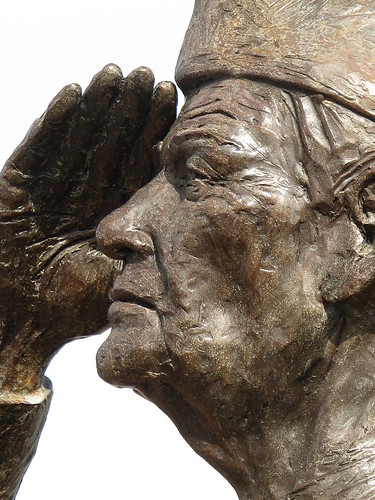
Here's a piece of sculpture from the Olympic Park that Jon pointed out to me that I thought was odd as hell...


until I read the plaque and was just moved to my soul.

The Olympic Park was full of things like this that give strong examples of how great humanity can be when it wants to be.

And finally, the guy who perhaps left the strongest impression on me was Kim Kyoung-Han, Korean national Judo team member, Asian Games Judo champion, trainer to the stars, and Kettlebell Korea staff member. Despite his formidable resume', Kim's demeanor is quiet, impeccably mannered, diligently disciplined, and generous to a fault. Knowing that I love the throwing arts, he took some time on a lunch break to share one of his favorite combinations with me. His teaching skill became readily apparent, and I thought immediately of featuring him in a full-feature spread in Black Belt Magazine.


On my last evening in Seoul, I wanted to he made arrangements to meet up with him to leave him a memento of one of the shining stars of American martial arts - a T-shirt from the world famous Inosanto Academy. He, however, completely one-upped me by presenting me with the Judo gi that he won the Asian Games in.


I'm back home now, more determined than ever to evolve into a better instructor, a better athlete, a better physician, and a better man.

To my co-instructor, Sr RKC Jon Engum, thank you for being there with me. I could not have wished for a better friend, guide, and TKD coach to have along with me. The next time, we're bringing the Viking & the Russian!

For the priceless gift of inspiration that came from so many directions, thank you, Korea!