Tuesday, April 23, 2013
Reality Check
There are some times that I'm really glad that I have a voice memo function on my iPhone. When I remember to use it, especially when I'm about to get into a conversation with someone who sounds like they have a good point, it can yield some pretty useful content.
-----
"Hey, Dr. Cheng, I think your Tai Cheng is perfect for some older folks & people coming back from injuries. It's really awesome for making people feel better!"
Oh, thank you so much for your kind words! Have you used it?
"No way, man. I'm an athlete. I can't get anything out of those slower workouts. My body needs to MOVE to burn off feel alive!" [with a big grin and a puffed out chest]
Oh, cool. Have you tried kettlebells before too?
"Oh, yeah! I got some DVDs from the gym & tried them, but they hurt my knees and interfered with my plyos."
Interesting. May I see you do a couple of Swings, please, with this 12kg bell?
"Sure!" [proceeds to demonstrate a squat-centric Swing with a slightly ounded back]
How would you rate your form on this exercise?
"Oh, I studied the DVDs. I know the Swing. I'm sure you could find some little correction though." [with a snide tone]
What if I told you that your execution on these exercises is actually hurting you? What if I told you that it's not only hurting your ability to do certain exercises, but also tearing your body apart? Would that alarm you at all?
"Well, I feel fine."
Really? For as hard as you workout & train, you should be able to not only run a mile without pain, but also do 60 seconds of box jumps without pain, get up & down out of a chair in a relaxed fashion without pain, and then hit 5 non-consecutive pullups without kipping and without pain. Can you do any of that and still tell me that you feel "fine"?
"Ummmm...." [blank expression]
Dude, you're TWICE my size. You should be able to Swing a 32kg kettlebell with absolute impunity if you used proper form and experienced IMPROVEMENT in your plyos, NOT impairment. An "athlete" should be someone who can not only handle activities of daily life, but who can also go above and beyond with their body. If how you train is forcing you to "supplement" with pain medication and Advil figures prominently on your grocery list, then you need a reality check, my friend. Sorry to have to put it to you this way, but I'm not going to sugar coat the truth for you..... You're training just for social bragging rights, not for long-term functionality or performance.
"Well, what exercises can I add to my workouts to get better?"
It's not what you can ADD to your workouts that will save you at this point. Right now, you're going to get the fastest & most lasting results by setting your ego aside just long enough to save your own life.
"Oh, like your boy Gray Cook says: Remove the negative. Right?"
Gray Cook is my mentor, but yes, right now, any exercise that you can't execute with proper form is a negative. There's nothing wrong with ANY exercise. The problem right now lies in how you execute those movement patterns. Your neuromuscular system needs a bit of re-training without any reinforcement of bad habits. Once you've accomplished that, I can almost guarantee that your physical output in your preferred training style will improve, but more importantly, you should be able to do your activities of daily life without having to waste energy bracing for pain. In other words, you'll get more out of your workout with less damage to your system.
"Right on! Sign me up! Is there a DVD or anything that has the stuff you're talking about in it?"
Absolutely. It's called Tai Cheng.
Labels:
athletics,
intelligence,
kettlebell swing,
precision movement,
tai cheng
Monday, February 11, 2013
Self-Recalibration
As a general rule, I like to take inventory of my life on a regular basis, much in the same way that I say that it's important to take inventory of your body's available ranges of pain-free motion in the Function Test of Tai Cheng. This is especially true for me around the Chinese New Year.
As I look at the faces of my children, reflect on the trials & tribulations of this past year (as well as the trials and tribulations of those close to my heart), examine the successes and strong points of those whom I respect, and reprioritize my resources based on who and what I have become, I've come to some important realizations that things must change in order to evolve.
I've been teaching for just over 2 decades, both privately and in group classes. At one time, I taught group classes 7 days a week, while I was an undergrad. Until very recently, I taught regular group classes only on Saturday & Sunday mornings at a martial arts school in West LA.
But as my son grows more teachable & impressionable, and I see my elders and peers age, it becomes more and more apparent to me that I need to honor the "last wishes" rule: e.g., if asked at the end of my life if I had any last wishes or regrets, what would those be?
Would they be that I didn't spend enough time teaching group classes?
Would they be that I didn't put enough effort into traveling the world?
Would they be that I didn't give enough to the people I've already been giving plenty to?
Highly improbable.
Especially this Chinese New Year, for some reason, my heart's been aching for me to devote more time to some pursuits that really define what I think are some of the best parts of my heritage, my legacy, my learning, and my skills... most of which revolve around the traditional Chinese martial arts.
All the good things that I've ever had in my life came to me through my involvement in the martial arts. I've made no secret of that, and anyone who's been following me knows that the martial arts & the traditional cultures surrounding them are my soul.
Effective immediately, I am hereby canceling the remainder of my group classes indefinitely and focusing on my own training & improvement as well as that of my children. Outside of my family members, those whom I teach with any semblance of regularity will be those who know how to appreciate what I teach and how I teach it, without weighing me down with responsibilities to change behaviors that I'm neither paid for nor entitled to regulate.
I will continue to teach at workshops (such as those of StrongFirst, Functional Movement Systems, Beachbody, or other groups that I am affiliated with). I will also continue to maintain my private client roster, although I will only be accepting new clients by referral only. A list of instructors that I've trained & recognize will be posted here in the coming weeks.
I'm also going to make a concerted shift to putting more & more of my best stuff on DVD, such as with Kettlebell Warrior, so that neither you or I are limited by time & space. If you want to learn what makes me tick, what lifts my heart, and what restores my body (as well as that of my patients & clients), then I'll do my best to make it accessible to you.
Looking forward to a strong, bright, and shining future to us all!
Wednesday, October 10, 2012
Emotional Attachments: Exercise, Identity, & Addiction
One of the most challenging things to deal with for exercise, rehab, & medical professionals is a client/patient's attachment to a particular form of exercise or sport. As my mentor, Gray Cook, pictured below with Master RKC Brett Jones, has often said, "It's probably easier to get someone to quit smoking crack than to get a runner to stop running long enough for you to get them functioning properly."
This, sadly, is one of the trademarks of modern fitness..... emotional addiction. And it's little surprise.
We spend so much of our lives limiting our movement, starting as early as pre-school. Instead of being outside, running, jumping, playing, and exploring our environment and our movement capabilities as we evolved to do, we're in class for hours each day, forced to sit in partial flexion, and receiving less and less education (and, in many cases, misinformation) as to what our bodies are really capable of.
Over time, our bodies start losing the ability to move in a fundamental fashion. Our cores become flaccid and our limbs become spastic. Yet, society and nature tell us that to be considered vital, to be considered sexy, we have to look great and move a lot.
Notice that I said "move a lot" and not "move well."
When you're hungry enough, you'll eat just about anything someone puts in front of you, and you'll scarf it down like it was the tastiest thing you've ever imagined. When you're dying for movement, or in some cases, dying from lack of movement, you're likely feeling the urge to make up for lost time by putting in a major dose of extra hard, super HIIT (high intensity interval training) or some other means by which you can feel the reward of sweating buckets, tons of adrenaline kicks, and bathe in endorphins bubbling forth from your goosebumps. Over time, you identify yourself with the means through which you experienced that high, and it becomes part of your psyche, your sociology, and your soul.
The problem with that is two-fold.
As Gray has said many times, "YOU ARE NOT YOUR WORKOUT OR YOUR SPORT. YOU ARE A HUMAN BEING."
While we're all driven by a need to belong, we need to realize that belonging to one group over another comes at a cost. You can see it in religion. You can see it in nationalism. You can see it in social cliques. And you can see it in human performance and medicine!
When someone is so driven to be a football player, a drummer, an attorney, a cyclist, a kettlebeller, a P90Xer, a violinist, a martial artist, an exotic dancer, an actor, a researcher, or whatever other pursuit that brings with it a label that pigeonholes how you move, how you live, and how you think of yourself, the body modifies itself to accommodate such specialization.... or as my old professor used to say, "The body is a conservative system."
If you live, work, or train in such a manner that you regularly compromise your body, you have to make sure that you are constantly repeating the IPDE loop - Identify, Predict, Decide, Execute.
* Identify possible dangers in your training, your sport, your job, or your workout routine.
Let me use myself as an example. I'm a lifelong martial artist. I love it. It moves me. It brings me incredible joy. It has been the reason why I've met some of the most influential people in my life..... and it has been the source of some of my most debilitating injuries. Because of my training in the martial art I love the most, Combat Shuai-Chiao, I've taken repeated high-throw falls until my hands didn't function properly.
* Predict how those dangers can affect your quality of life in the BROADEST possible sense.
Again, using myself as an example, that repeated whiplash & impact from hard throws & improper breakfalls is a danger that can affect my performance as a clinician, as a strength coach, as a martial artist, and most importantly as a father if my fine motor skills are impaired by any compromise in the structures and soft tissue around my C-spine.
NOTE WELL: Chronic stiffness and aches (even if not "crippling" in intensity) impair sleep, energy levels, strength, mental clarity, mood, and performance. Just because it doesn't hurt you badly enough for you to stop dead in your tracks, don't think it isn't affecting your performance AND your quality of life. Compensation is sinister.... until it's obvious.
* Decide how you're going to manage those dangers & liabilities in such a way as to minimize or eliminate risk. In a lot of ways, this is the step in which you have to either FULLY and CONSCIOUSLY accept the effects and consequences of what your chosen pursuit is. If you choose to define yourself via your pursuit, then you need to also maintain your fullest abilities as a human being OUTSIDE of your specific skill. For example, if you're a violinist, you need to make a plan to optimize your upper body ranges of motion outside of drawing the bow, finger placement, and keeping your jaw on the chin rest.
For myself, that means figuring out how best to both rehab my neck & injured joints while also minimizing the damage from repeated hard falls. Through lots of research, experimentation, & work, I've identified the prehab training methods that will strengthen my body to be more resilient. I've also identified the passive treatment modalities that I need to implement regularly to keep myself at my functional best. And finally, I realized that using a crash mat is a sign of intelligence and not weakness. Hard-charging athletes need to realize that safety is a sign of long term vision, not wimping out!
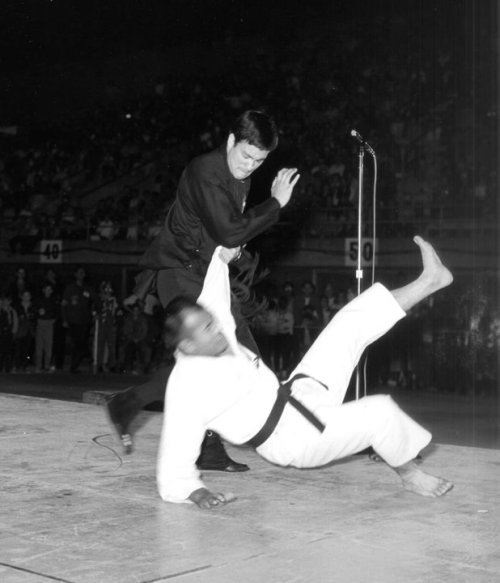
As Guro Dan Inosanto, pictured below demonstrating with Bruce Lee on a hardwood floor, has said many times, the older generations did things a certain way because of what they had available at the time. Ancient martial artists trained hard with no protection because such gear had not yet been invented. Earlier generations trained with some protection because they invented it. We as the newer generations have luxuries afforded to us that were simply unavailable in decades past. Since we have these improvements in safety gear, we should be able to train to a high level for a longer duration than our predecessors with less injury. Not using such safety gear, corrective exercises, or other improvements out of allegiance to "how the old timers did it" is myopic at best.
* Execute the plan you decided on. As Gray Cook would say, "Consistency trumps intensity every time." Doing your prescribed corrective or rehabilitative exercises once or twice and then complaining that they don't work is not a sign of either awareness or honesty. It takes time to develop a neuromuscular habit, and it'll take repeated practice to groove a new, better, safer, stronger neuromuscular behavior pattern.
Don't believe me? Great... Keep doing things your way & prove to me over the long-run that your way is correct. Until then, I'll keep studying, keep practicing, keep refining, and keep making the most of the hard-earned information that we have at our disposal these days.
Do the half-kneeling chops to prevent your lower back pain from the golfing. Do the Tai Cheng to keep your neck & shoulders from aching so much after your hours behind the desk. Do the deadlifting to make sure you're developing the posterior chain & postural reflexes after those long bike rides. Do the soft tissue treatment to make sure you're keeping the optimal elasticity in your muscles. Do the non-sport-specific endurance work to make sure you have the capacity to maintain a higher level of performance throughout a match or event. Do the flexibility/mobility work to make sure your body can handle the unexpected ranges of motion of sport. Do the seemingly remedial stuff to make sure that you do the higher level stuff in an even safer, smoother manner. Do the explosive plyometrics, such as those found in workouts like P90X or training systems like Parkour, that force you to learn how to handle speeds and vectors that are outside of what you're used to.
Outside of movement, change up the music that you listen to on occasion. Vary your eating/dietary patterns. Study a new language. Make new friends. Don't be content with mere survival and don't let yourself become stagnant.
Human beings were meant to be so much more than what most of us conceive of ourselves as today. While we have learned to be tremendous specialists, we've lost so many of our abilities that, generation after generation, it's killing us in a more & more sinister manner. Because the familiar is comfortable, we've become addicts to routine and have prided ourselves on identifying with our addictions.
As MovNat founder, Erwan LeCorre said, "Adaptability is the Holy Grail of human evolution." So let's break our addictions and live our lives in a way that honors our many areas of evolution. This, in turn, will thereby improve how we both live our daily lives and perform in sport-specific conditions.
This, sadly, is one of the trademarks of modern fitness..... emotional addiction. And it's little surprise.
We spend so much of our lives limiting our movement, starting as early as pre-school. Instead of being outside, running, jumping, playing, and exploring our environment and our movement capabilities as we evolved to do, we're in class for hours each day, forced to sit in partial flexion, and receiving less and less education (and, in many cases, misinformation) as to what our bodies are really capable of.
Over time, our bodies start losing the ability to move in a fundamental fashion. Our cores become flaccid and our limbs become spastic. Yet, society and nature tell us that to be considered vital, to be considered sexy, we have to look great and move a lot.
Notice that I said "move a lot" and not "move well."
When you're hungry enough, you'll eat just about anything someone puts in front of you, and you'll scarf it down like it was the tastiest thing you've ever imagined. When you're dying for movement, or in some cases, dying from lack of movement, you're likely feeling the urge to make up for lost time by putting in a major dose of extra hard, super HIIT (high intensity interval training) or some other means by which you can feel the reward of sweating buckets, tons of adrenaline kicks, and bathe in endorphins bubbling forth from your goosebumps. Over time, you identify yourself with the means through which you experienced that high, and it becomes part of your psyche, your sociology, and your soul.
The problem with that is two-fold.
As Gray has said many times, "YOU ARE NOT YOUR WORKOUT OR YOUR SPORT. YOU ARE A HUMAN BEING."
While we're all driven by a need to belong, we need to realize that belonging to one group over another comes at a cost. You can see it in religion. You can see it in nationalism. You can see it in social cliques. And you can see it in human performance and medicine!
When someone is so driven to be a football player, a drummer, an attorney, a cyclist, a kettlebeller, a P90Xer, a violinist, a martial artist, an exotic dancer, an actor, a researcher, or whatever other pursuit that brings with it a label that pigeonholes how you move, how you live, and how you think of yourself, the body modifies itself to accommodate such specialization.... or as my old professor used to say, "The body is a conservative system."
If you live, work, or train in such a manner that you regularly compromise your body, you have to make sure that you are constantly repeating the IPDE loop - Identify, Predict, Decide, Execute.
* Identify possible dangers in your training, your sport, your job, or your workout routine.
Let me use myself as an example. I'm a lifelong martial artist. I love it. It moves me. It brings me incredible joy. It has been the reason why I've met some of the most influential people in my life..... and it has been the source of some of my most debilitating injuries. Because of my training in the martial art I love the most, Combat Shuai-Chiao, I've taken repeated high-throw falls until my hands didn't function properly.
* Predict how those dangers can affect your quality of life in the BROADEST possible sense.
Again, using myself as an example, that repeated whiplash & impact from hard throws & improper breakfalls is a danger that can affect my performance as a clinician, as a strength coach, as a martial artist, and most importantly as a father if my fine motor skills are impaired by any compromise in the structures and soft tissue around my C-spine.
NOTE WELL: Chronic stiffness and aches (even if not "crippling" in intensity) impair sleep, energy levels, strength, mental clarity, mood, and performance. Just because it doesn't hurt you badly enough for you to stop dead in your tracks, don't think it isn't affecting your performance AND your quality of life. Compensation is sinister.... until it's obvious.
* Decide how you're going to manage those dangers & liabilities in such a way as to minimize or eliminate risk. In a lot of ways, this is the step in which you have to either FULLY and CONSCIOUSLY accept the effects and consequences of what your chosen pursuit is. If you choose to define yourself via your pursuit, then you need to also maintain your fullest abilities as a human being OUTSIDE of your specific skill. For example, if you're a violinist, you need to make a plan to optimize your upper body ranges of motion outside of drawing the bow, finger placement, and keeping your jaw on the chin rest.
For myself, that means figuring out how best to both rehab my neck & injured joints while also minimizing the damage from repeated hard falls. Through lots of research, experimentation, & work, I've identified the prehab training methods that will strengthen my body to be more resilient. I've also identified the passive treatment modalities that I need to implement regularly to keep myself at my functional best. And finally, I realized that using a crash mat is a sign of intelligence and not weakness. Hard-charging athletes need to realize that safety is a sign of long term vision, not wimping out!
As Guro Dan Inosanto, pictured below demonstrating with Bruce Lee on a hardwood floor, has said many times, the older generations did things a certain way because of what they had available at the time. Ancient martial artists trained hard with no protection because such gear had not yet been invented. Earlier generations trained with some protection because they invented it. We as the newer generations have luxuries afforded to us that were simply unavailable in decades past. Since we have these improvements in safety gear, we should be able to train to a high level for a longer duration than our predecessors with less injury. Not using such safety gear, corrective exercises, or other improvements out of allegiance to "how the old timers did it" is myopic at best.
* Execute the plan you decided on. As Gray Cook would say, "Consistency trumps intensity every time." Doing your prescribed corrective or rehabilitative exercises once or twice and then complaining that they don't work is not a sign of either awareness or honesty. It takes time to develop a neuromuscular habit, and it'll take repeated practice to groove a new, better, safer, stronger neuromuscular behavior pattern.
Don't believe me? Great... Keep doing things your way & prove to me over the long-run that your way is correct. Until then, I'll keep studying, keep practicing, keep refining, and keep making the most of the hard-earned information that we have at our disposal these days.
Do the half-kneeling chops to prevent your lower back pain from the golfing. Do the Tai Cheng to keep your neck & shoulders from aching so much after your hours behind the desk. Do the deadlifting to make sure you're developing the posterior chain & postural reflexes after those long bike rides. Do the soft tissue treatment to make sure you're keeping the optimal elasticity in your muscles. Do the non-sport-specific endurance work to make sure you have the capacity to maintain a higher level of performance throughout a match or event. Do the flexibility/mobility work to make sure your body can handle the unexpected ranges of motion of sport. Do the seemingly remedial stuff to make sure that you do the higher level stuff in an even safer, smoother manner. Do the explosive plyometrics, such as those found in workouts like P90X or training systems like Parkour, that force you to learn how to handle speeds and vectors that are outside of what you're used to.
Outside of movement, change up the music that you listen to on occasion. Vary your eating/dietary patterns. Study a new language. Make new friends. Don't be content with mere survival and don't let yourself become stagnant.
Human beings were meant to be so much more than what most of us conceive of ourselves as today. While we have learned to be tremendous specialists, we've lost so many of our abilities that, generation after generation, it's killing us in a more & more sinister manner. Because the familiar is comfortable, we've become addicts to routine and have prided ourselves on identifying with our addictions.
As MovNat founder, Erwan LeCorre said, "Adaptability is the Holy Grail of human evolution." So let's break our addictions and live our lives in a way that honors our many areas of evolution. This, in turn, will thereby improve how we both live our daily lives and perform in sport-specific conditions.
Labels:
adaptability,
addiction,
dan inosanto,
evolution,
football,
gray cook,
movnat,
p90x,
tai cheng
Thursday, July 19, 2012
The Beachbody Ultimate Reset - Vegan Diets, Strength training,
Tomorrow morning will be my post Beachbody Ultimate Reset physical & bloodwork. I've gotten a few private messages, emails from friends, & tweets asking about the Reset & "how hard it is", etc...
It really boils down to this: Decide, Commit, Succeed.
If you've decided to do the Reset & aren't so sure about the strength of your commitment, then minimize your distractions/temptations & print out papers with HUGE letters that say the following sentence: "Stick to the rules & keep things simple." Post them on your fridge, on the pantry, & wherever you might keep food/snacks.
Schedule as few social engagements as possible during the 21 days of your Reset. The less you're going to be "pressured" into eating, the less likely you are to cheat. But seriously, if you WANT to do something, you'll do it. If you WANT to stick to the Reset, then nothing anyone says will sway you from it. Likewise, if you aren't committed to the Reset (or whatever else), nothing anyone says will keep you to it.
Allow yourself some leeway to skip/replace a meal with intelligence & integrity. Choose something that doesn't violate the Reset principles. On days where I was teaching kettlebells or martial arts for longer stints & didn't have a cooler or fridge to keep perishable fresh food in, I brought along a protein bar with ingredients that were in keeping with the vegan concepts of the Reset. The bar I chose is available at http://bit.ly/DRproteinbars and is vegan, gluten-free, & dairy-free. Also, if you have a particular food allergy or sensitivity, modify the Reset to avoid ingredients that might set off your symptoms.
Finally, don't pay attention to the rubbish that people say about needing to eat meat to function athletically, to have energy, for their sex drive, etc... People's bodies get metabolically trained to function on a certain type of food, and because they rarely ever spend enough time training their body to be metabolically flexible, they're never really free of their dependence on that type of food. Humans evolved as opportunistic omnivores, meaning we should be able to eat whatever is naturally available to us & still function well. The majority of people that I hear screaming about needing to eat meat ALL the time don't exactly look (or move) like what I'd imagine a primordial hunting bada$$ to look like, so don't buy into the hype.
As far as the sex drive issue, that's an absolute crock. Here's a personal vignette... When I was still in college & was teaching Tai Chi at a local health club, one of the older guys who always had the attention of the ladies in the club told me that one of his secrets was to spend an entire day eating fruits & vegetables before he was going to spend the night with a woman that he was dating. He explained that the fruits & vegetables are cleaner fuel for your system & easier to digest faster, leaving more blood to supply other parts of your body. Additionally, the fruits don't create the same body odors that meats do, de-necessitating strong, artificial deodorants. So like I said before, don't believe someone else's ill-informed hype.
If you want to do something, do it all the way & finish what you start! Then enjoy the results!
Tuesday, May 15, 2012
I'm BACK!
While I may have been away for quite some time & let this blog gather a few cobwebs, it's time for a revival! I've been working hard on a variety of different projects, including a new portal website, but I think that it's time to rejuvenate & update this blog, since it's already established.
In the coming weeks, I'll be posting quite a bit more content on everything from the Tai Cheng program that I created with Beachbody, to the Hardstyle Kettlebell Certification, RKC, & CK-FMS courses that I'll be teaching in Los Angeles, Seoul, & St. Paul, to other odds & ends in the world of human performance.
While this blog was originally entitled kettlebellslosangeles.blogspot.com, it's grown far beyond the realm of kettlebells & strength training. There's so much that I've been privileged to learn & experience in clinical medicine, in martial arts, in injury rehab, and in life that I want to share with you, and I'm going to work towards making this blog a much better means of achieving that.
So thanks for your patience, and look forward to some great stuff coming down the line! If you haven't done so already, please follow my public Facebook page!
In the coming weeks, I'll be posting quite a bit more content on everything from the Tai Cheng program that I created with Beachbody, to the Hardstyle Kettlebell Certification, RKC, & CK-FMS courses that I'll be teaching in Los Angeles, Seoul, & St. Paul, to other odds & ends in the world of human performance.
While this blog was originally entitled kettlebellslosangeles.blogspot.com, it's grown far beyond the realm of kettlebells & strength training. There's so much that I've been privileged to learn & experience in clinical medicine, in martial arts, in injury rehab, and in life that I want to share with you, and I'm going to work towards making this blog a much better means of achieving that.
So thanks for your patience, and look forward to some great stuff coming down the line! If you haven't done so already, please follow my public Facebook page!
Saturday, January 8, 2011
Kettlebells for Beginners
Photo courtesy of Coach Ron Jones, KBLA RKC
If you've decided to start training with kettlebells and devote time to experiencing the improvements that they can offer you, you'll need to actually get your hands on some kettlebells! BUT WHICH ONES?!?
Here's my personal guideline.
Because the most fundamental exercises in kettlebell training are the Swing & the Turkish Get-Up, I strongly suggest having two different kettlebells. If you're thinking that having to shell out the money for two kettlebells is expensive, let me tell you that coming to see a doctor or therapist after you injure yourself trying to be a badarse with horribly compensated technique is much more expensive.
Invest on the front end, reap on the back end. Skimp on the front end, pay terribly on the back end.
The lighter kettlebell will allow you to learn the Turkish Get-Up with a weight that should allow you to be challenged safely without being too stressed to pay attention to good form. It will also allow you to make tweaks to your Swing form without great risk of injury to yourself.
Men - You'll ideally need both a 12kg (26lb) kettlebell and a 20kg (44lb) kettlebell. I know, I know, I know... You bench press with 5 plates on each side & can squat with a buffalo on your back. I don't care. The Swing & Turkish Get-Up CAN be done as strength movements, but finesse and technique are primary concerns in the RKC method - NOT brute strength. Remember that every point of technique you overlook will come back to haunt you eventually. Trust me on that.
Ladies - You'll ideally need both a 14lb kettlebell and a 16kg (35lb) kettlebell.
Now if you're one of those folks who's ridiculously strong, coordinated, and un-injured, you can certainly err towards the larger sized kettlebells. As long as you can maintain correct form on BOTH sides for Pavel's Program Minimum, which I believe he goes over in Enter the Kettlebell, use whatever sized bell you want. Remember that the sizes I mentioned in this post are nothing more than general guidelines for the average male & female based on my experiences in teaching around the world.
Remember, too, that NOTHING takes the place of working on the above exercises with a skilled instructor, not just a skilled athlete!
Labels:
kettlebell sizes,
program minimum
Saturday, December 11, 2010
Proprioception is Sexy - RKC Snatch Test Preparation & other Sports Performance applications
It never fails. Regardless of the field of endeavor, there's always someone with a serious disconnect between reality and actuality. Like the word proprioception. Would you think that something so nerdy could be sexy?
Let's look at how that works with movement, for example. If you've ever lifted a weight overhead as an adult, the odds are pretty good that when you thought you achieved the lockout position, you probably were a bit shy of straight at the elbow. Nonetheless, you were probably dead sure that you'd locked out that elbow and pressed or snatched that heavy weight to a perfect apex.
Sorry to break this to you, but you might've missed the lockout.
If you've ever done the RKC Snatch Test and heard the words "No count!", that could've very well happened because of an incomplete lockout. Yeah, I know you're sure. I know you've never had a no-count doing the snatch test at home. I know your form is perfect.... when YOU'RE THE JUDGE!
Subjectivity is the primary means of enabling the self towards failure. And as the legendary Functional Movement Screen founder Gray Cook says, "We all need systems to protect us from our own subjectivity." So the system that we need to refine is that which gives us feedback as to whether or not we're really moving the way we think we're moving and takes away our ability to argue defensively like bratty little children.
Proprioception is the ability to distinguish where one part of the body is in relation to another. We develop that ability somewhat as children during the growth process. In the years from newborn to childhood, you developed the ability to go from randomly poking yourself in the eye to picking that booger out with surgical precision. But with our increasingly sedentary lifestyles (and even in grade school since physical education programs got the ax years ago), proprioceptive deficits are building up faster than fat on the waistlines of American youth.
And as a result, you get to hear about proprioception from me. But here's the good part... Proprioception IS sexy!
Good proprioception affords you two very big advantages.
1. Accuracy in movement - which means that you very likely execute very precise, very controlled, very graceful, and very efficient movements. If you have great awareness of your own movement, then when your nervous system tells you that you locked out, then you REALLY did lock out. If your body is telling you that you locked out your back leg on that stance, then your Sifu likely agrees with you too. If your nervous system is masterfully in control of your body's movement, then that fadeaway jumpshot that you launched from 3-point land has a much higher likelihood of creating that sweet sound of nothing-but-net. That makes you not only a better athlete, but a more attractive specimen as well. Not to rip on bodybuilders, but you could be the most buff dude on the beach & unable to tuck your own shirt in.
2. Reduced injury rates - make everybody happier, except your competition. Someone with great proprioception can push harder on the field or in battle and get more out of his or her body. Someone with terrible proprioception will push hard and either waste move clumsily & get hurt or lurch like a car with the parking brakes on and create repetitive motion injury.
So for those of you who want to come to the RKC, I encourage you to find the strictest feedback mechanism that you can find (like a combination of Flip video & a solidly qualified instructor) and apply it mercilessly towards yourself. Why? Because if you're allowed to lie to yourself, you probably will. And your reliance on faulty proprioception may cost you a rather pricey certification, airfare, & lodging (as well as a few days off from work and wickedly sore muscles).
On the other hand, if you use this blogpost as a call to really invest the effort into re-calibrating your proprioception, you'll find that you not only perform better under pressure, but do so with less effort, more grace, and a decreased likelihood of injury.
If you're not interested in the RKC, no problem. But you STILL have to deal with the reality of your own movement patterns and develop a REAL awareness of them. As I often tell my students in martial arts, kettlebells, or any other form of movement, if I tell you to do something such as straightening your leg, and you think you're already straightening your leg, try to straighten it a little more anyways. If your leg moves, then you didn't have it as straight as you could have. And then that little bit of movement should humble you enough to self-check more & more and develop sharper & sharper awareness of your body and your control over it.
Don't wait until life takes away all your compensations before you take the time to self-check your perceptions against unflinching reality.
Let's look at how that works with movement, for example. If you've ever lifted a weight overhead as an adult, the odds are pretty good that when you thought you achieved the lockout position, you probably were a bit shy of straight at the elbow. Nonetheless, you were probably dead sure that you'd locked out that elbow and pressed or snatched that heavy weight to a perfect apex.
Sorry to break this to you, but you might've missed the lockout.
If you've ever done the RKC Snatch Test and heard the words "No count!", that could've very well happened because of an incomplete lockout. Yeah, I know you're sure. I know you've never had a no-count doing the snatch test at home. I know your form is perfect.... when YOU'RE THE JUDGE!
Subjectivity is the primary means of enabling the self towards failure. And as the legendary Functional Movement Screen founder Gray Cook says, "We all need systems to protect us from our own subjectivity." So the system that we need to refine is that which gives us feedback as to whether or not we're really moving the way we think we're moving and takes away our ability to argue defensively like bratty little children.
Proprioception is the ability to distinguish where one part of the body is in relation to another. We develop that ability somewhat as children during the growth process. In the years from newborn to childhood, you developed the ability to go from randomly poking yourself in the eye to picking that booger out with surgical precision. But with our increasingly sedentary lifestyles (and even in grade school since physical education programs got the ax years ago), proprioceptive deficits are building up faster than fat on the waistlines of American youth.
And as a result, you get to hear about proprioception from me. But here's the good part... Proprioception IS sexy!
Good proprioception affords you two very big advantages.
1. Accuracy in movement - which means that you very likely execute very precise, very controlled, very graceful, and very efficient movements. If you have great awareness of your own movement, then when your nervous system tells you that you locked out, then you REALLY did lock out. If your body is telling you that you locked out your back leg on that stance, then your Sifu likely agrees with you too. If your nervous system is masterfully in control of your body's movement, then that fadeaway jumpshot that you launched from 3-point land has a much higher likelihood of creating that sweet sound of nothing-but-net. That makes you not only a better athlete, but a more attractive specimen as well. Not to rip on bodybuilders, but you could be the most buff dude on the beach & unable to tuck your own shirt in.
2. Reduced injury rates - make everybody happier, except your competition. Someone with great proprioception can push harder on the field or in battle and get more out of his or her body. Someone with terrible proprioception will push hard and either waste move clumsily & get hurt or lurch like a car with the parking brakes on and create repetitive motion injury.
So for those of you who want to come to the RKC, I encourage you to find the strictest feedback mechanism that you can find (like a combination of Flip video & a solidly qualified instructor) and apply it mercilessly towards yourself. Why? Because if you're allowed to lie to yourself, you probably will. And your reliance on faulty proprioception may cost you a rather pricey certification, airfare, & lodging (as well as a few days off from work and wickedly sore muscles).
On the other hand, if you use this blogpost as a call to really invest the effort into re-calibrating your proprioception, you'll find that you not only perform better under pressure, but do so with less effort, more grace, and a decreased likelihood of injury.
If you're not interested in the RKC, no problem. But you STILL have to deal with the reality of your own movement patterns and develop a REAL awareness of them. As I often tell my students in martial arts, kettlebells, or any other form of movement, if I tell you to do something such as straightening your leg, and you think you're already straightening your leg, try to straighten it a little more anyways. If your leg moves, then you didn't have it as straight as you could have. And then that little bit of movement should humble you enough to self-check more & more and develop sharper & sharper awareness of your body and your control over it.
Don't wait until life takes away all your compensations before you take the time to self-check your perceptions against unflinching reality.
Labels:
awareness,
compensations,
proprioception,
sex
Subscribe to:
Comments (Atom)